
If you’re manufacturing prescription drugs for the US market, DSCSA compliance isn’t a future requirement. It’s active law today, and your trading partners expect fully serialized, electronic data from day one.
This playbook breaks down what DSCSA compliance actually requires operationally, drawing on a real implementation from Yogendra Upadhyay, Assistant General Manager at Mankind Pharmaceuticals, who has taken multiple production lines through the process. For the broader picture across every market, see our pharmaceutical serialization guide.
What Is DSCSA and Why It Exists
So what is DSCSA? The Drug Supply Chain Security Act became law in November 2013. In practical terms, it requires an electronic system that traces every prescription drug package, unit by unit, through the US supply chain – closing the door on counterfeit, mislabeled, or diverted product reaching patients.
DSCSA requirements apply regardless of where the product is physically made. DSCSA requirements for manufacturers hold whether you produce domestically or overseas. If you sell into the US, DSCSA compliance applies to you, full stop.
DSCSA Timeline, Deadlines, and Exemptions
The DSCSA timeline moved in phases, and understanding where each one sits matters for anyone still mapping out their own DSCSA implementation timeline.
2017 – Serialization phase. Manufacturers had to encode a unique product identifier into a 2D data matrix barcode on every saleable unit, carrying the GTIN, serial number, lot, and expiration date. In the US, that GTIN is built around the product’s NDC, which is why US serialization can’t simply reuse the identifier structure other markets use.
2023–2025 – Enhanced Drug Distribution Security (EDDS). This is the harder DSCSA serialization requirement: electronic package-level tracing across the full supply chain, built on pharmaceutical aggregation as the operational layer that makes it possible. EDDS enforcement came into force for manufacturers in 2023, expanding to repackagers and wholesale distributors in 2025.
2025–2026 – Dispenser deadlines. Larger dispensers were required to comply in 2025; smaller pharmacies were given additional time into 2026.
There’s no broad DSCSA exemptions category left standing for manufacturers at this point. The DSCSA serialization deadline has passed. Your authorized trading partner expects full electronic serialized data now, not eventually, and any DSCSA implementation still in progress needs to treat that as the baseline, not the goal.
DSCSA Serialization Requirements: Barcodes, GLN, and GS1 Registration
DSCSA serialization requirements go beyond just printing a barcode. Every saleable unit needs a compliant 2D data matrix barcode encoding the GTIN, serial number, lot number, and expiration date – and increasingly, systems need to reference a GLN (Global Location Number) to identify specific facilities and trading partners in EPCIS transactions. Manufacturers new to GLN DSCSA requirements often assume GTIN alone covers them; it doesn’t. GLNs identify where an event happened, GTINs identify what product moved.
GS1 registration is simpler than most manufacturers expect. Contact your local GS1 office with your FDA-assigned NDC label code and request a GS1 company prefix. From there, you can build your own GTINs and, if needed, your own GLNs. For the US specifically, the NDC has to be included in GTIN construction – a structural difference from how other countries build their identifiers.
Packaging Development Is Where DSCSA Serialization Compliance Actually Starts
It’s tempting to think DSCSA barcode requirements mean adding a code to existing packaging. In practice, pharmaceutical serialization compliance is a packaging engineering problem that starts long before anything touches a line.
“It’s a start on paper, not on the line,” says Yogendra Upadhyay. “The first decision was where to place the 2D DataMatrix barcode, because that was new to the market and we already had existing artwork with regulatory text at fixed font sizes we couldn’t shrink.”
The barcode has to work within artwork that already carries fixed regulatory text, needs a quiet zone the camera can read, has to survive glossy cartons that cause light reflection, and has to scan reliably at real production speeds – not just look right on a design proof. Manufacturers who involve packaging development and their line-level solution provider early avoid discovering, after artwork is finalized, that the barcode position doesn’t work on the actual line.
Aggregation decisions belong in this early phase too, even before a country requires aggregation. “If the code faces the wrong way inside the case,” Upadhyay explains, “the system cannot verify it- so your line cannot check its own work.”
Three things matter most for pharmaceutical serialization regulations to translate into a working line:
- Collaborate early with packaging development and your line provider before artwork is finalized.
- Design for aggregation from the start rather than retrofitting it.
- Keep printing technology flexible. Manufacturers who commit to inkjet early sometimes find it can’t hold the line speed or print quality they need, and switch to TTO or laser mid-project – often for cold chain products where surface conditions matter as much as speed.
Implementing DSCSA Track and Trace at the Line Level
Once artwork is final, the line gets a printer, a vision camera, and a rejection mechanism – what the industry calls L1 equipment. These devices print and verify the serial number in real time, satisfying the core track and trace requirements for pharmaceutical manufacturers at the unit level. L2, the line controller, coordinates L1 with the rest of the packaging line and pulls a failed unit before it reaches finished goods.
Hardware installation is usually the easy part. The real challenge is integration – connecting the system to ERP and to the site-level L3 system, then validating the whole thing under full qualification (FAT, SAT, IQ, OQ, and PQ) before commercial production starts.
Vision inspection validation can’t stop at the serialization equipment alone. A conveyor running slightly out of sync with the printer or camera creates a speed mismatch that drags down line OEE even when the serialization system itself is working correctly. Operators also need real hands-on practice during performance qualification, not just a walkthrough – anything unfamiliar on the line shows up as downtime later.
The DSCSA Aggregation Requirement: From Case to Pallet
The DSCSA aggregation requirement is where serialized units become traceable shipments. Aggregation builds the parent-child data relationship between a unit, the case it’s packed in, and the pallet it ships on – and that relationship has to survive everything that happens after the packaging line.
Serialization and aggregation done well on the line can still fail in the warehouse. A case gets damaged, a label becomes unreadable, and someone has to re-aggregate it correctly before it ships – or the compliance record breaks even though the physical product is fine. This is often the most fragile link in the entire chain, not because the technology is harder here, but because exception handling depends on trained people making the right call under time pressure.
Manufacturers evaluating their warehouse readiness should ask for a solution built around real aggregation exception scenarios, not just the happy path, and should look at smart palletizing as a way to reduce how often a shipping error becomes a compliance error.
DSCSA Serialization Data Flow: EPCIS, ERP, and the L1–L4 Architecture
DSCSA is, at its core, a data compliance law. The physical product means little without EPCIS data behind it, and that data moves in both directions – not just up from the plant.
Before production starts, ERP sends batch details down to the site-level L3 server, and the L4 enterprise system sends down a pool of serial numbers, so the line has everything it needs before the batch begins. This is where ERP for EPCIS DSCSA integration actually happens – not as an afterthought, but as a precondition for starting the batch.
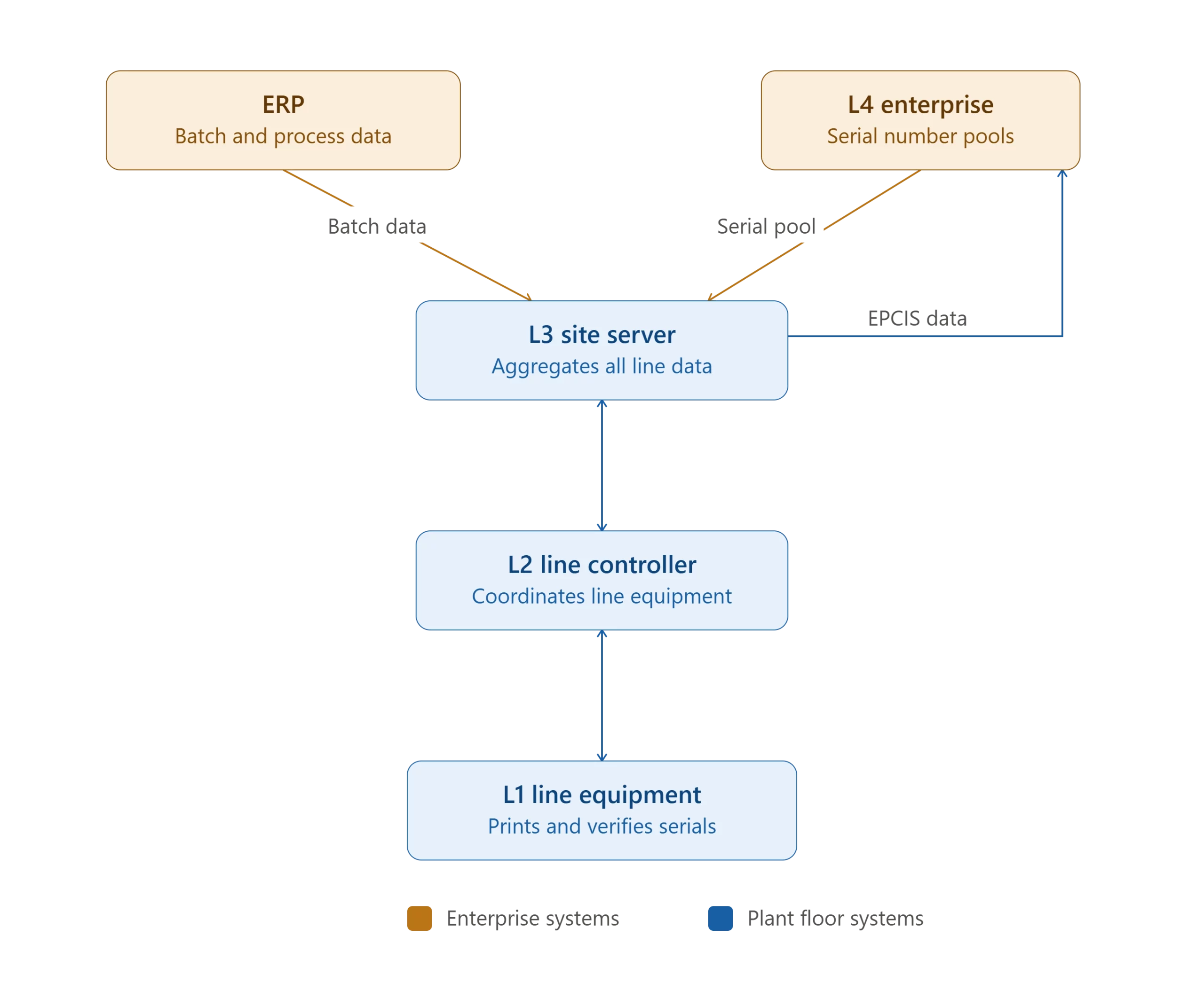
During production, data flows the other way: L1 to L2 to L3, which aggregates records across every line at the site, then up to L4 for EPCIS reporting to trading partners. When a shipment goes out, or rework happens at the plant, more data flows up again – a constant two-way exchange from before the first unit is made to after the last case ships.
Retention matters too. Records need to be kept for at least the product’s shelf life plus one year, which for longer-shelf-life products can mean six years or more. If a query comes in during that window and the data isn’t reliably stored, that’s a compliance failure independent of anything that happened on the physical line.
What DSCSA Compliance Solutions Actually Cost
Every DSCSA implementation carries a temporary hit to line efficiency. False rejects are common early, as vision systems get calibrated and operators adjust to a new process. The FDA’s own guidance acknowledges a stabilization period – performance typically returns close to baseline once the process stabilizes, so plan for that window rather than expecting day-one output to match your existing line.
Total cost of ownership goes beyond equipment price. Integration, validation, operator training, consumables, and ongoing support all add up, and a solution that looks cheaper on paper can cost more once those are factored in. When evaluating DSCSA compliance solutions, it’s worth choosing a platform that scales – not just across lines and sites, but across the other countries your product may eventually need to reach. A line built only for US DSCSA compliance today may need to meet a different country’s requirements tomorrow, and rebuilding that capability later costs more than planning for it now. If your current TCO already looks harder to justify than it should, that’s usually the point where switching serialization software becomes worth evaluating.