
What Are Vision Systems in Pharmaceutical Manufacturing?

Vision systems are automated inspection technologies that use cameras, lighting, and software to analyze products on production lines. Their role is simple: detect defects, verify compliance, and ensure consistency at high speed.

In pharma, this includes tasks like checking tablet integrity, verifying label accuracy, and confirming serialization codes. Unlike manual inspection, vision systems operate continuously and with repeatable accuracy.

For example, on a blister packaging line, a vision system can instantly detect a missing tablet or a broken seal, something a human operator might miss after hours of repetitive work.
Why Vision Systems Are Critical in Pharma

Why Vision Systems Are Critical in Pharma?

Pharmaceutical manufacturing operates under strict quality and regulatory expectations. Even minor defects can lead to recalls, compliance issues, or patient risk.

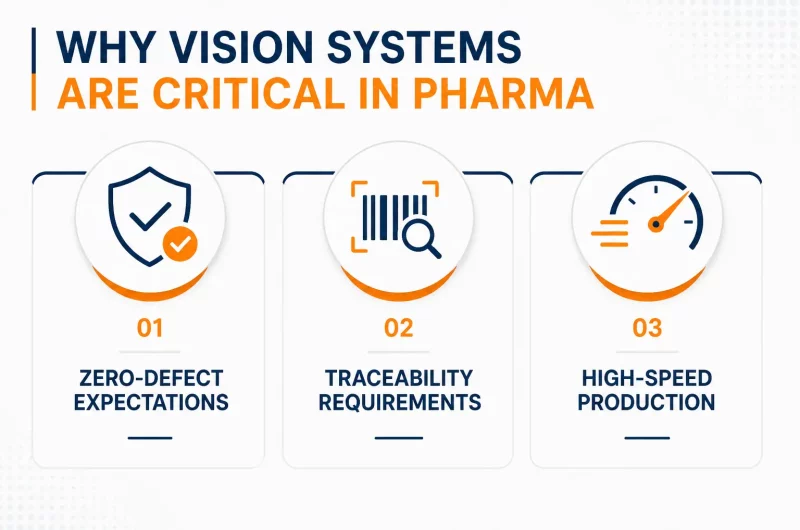
Vision systems address three core needs:

  • Zero-defect expectations: Automated inspection reduces variability and human error.
  • Traceability requirements: Serialization and code verification ensure every unit is trackable.
  • High-speed production: Manual inspection cannot keep up with modern line speeds.

In practice, a manufacturer producing thousands of units per minute cannot rely on human inspection alone. Vision systems ensure every unit is checked without slowing production.

How Vision Systems Work

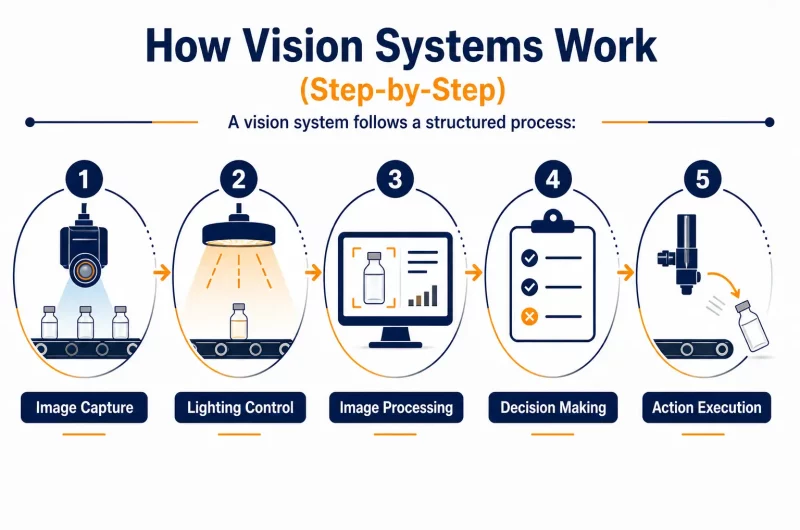
How Vision Systems Work (Step-by-Step)

A vision system follows a structured process:

  1. Image Capture: Cameras capture high-resolution images of products as they move along the line.
  2. Lighting Control: Specialized lighting highlights specific features (e.g., defects, text, codes).
  3. Image Processing: Software analyzes the image using predefined rules or AI models.
  4. Decision Making: The system compares results against quality standards.
  5. Action Execution: Defective products are rejected automatically.

Example: On a labeling line, the system captures each label, checks alignment and text accuracy, and rejects any misprinted unit in real time.

Types of Vision Systems in Pharma

Vision systems vary based on complexity and application:

  • 2D Vision Systems: Standard inspection (labels, presence/absence checks).
  • 3D Vision Systems: Depth analysis for shape, volume, or fill level verification.
  • AI-Powered Vision Systems: Use machine learning to detect complex or variable defects.
  • Smart Camera Systems: Compact, all-in-one units for simpler applications.

A small packaging line might use smart cameras, while a high-speed sterile line may require AI-driven multi-camera systems.

Key Use Cases in Pharmaceutical Manufacturing

Vision systems are deployed across the production lifecycle:

  • Blister Inspection: Detects missing or broken tablets.
  • Label Verification: Ensures correct product and regulatory information.
  • Serialization & Code Reading: Validates barcodes and data matrix codes.
  • Fill Level Inspection: Confirms correct liquid volume in vials.
  • Packaging Integrity: Checks seals, caps, and closures.

Example: A vaccine manufacturer uses vision systems to verify vial fill levels and cap placement before distribution.

Benefits of Vision Systems
Vision systems deliver measurable operational improvements:
Key Benefits
01
Improved Quality
Consistent, objective inspection.
02
Reduced Waste
Early defect detection prevents downstream losses.
03
Regulatory Confidence
Automated documentation and validation.
04
Higher Throughput
Inspection at production speed.
05
Lower Labor Dependency
Reduced reliance on manual checks.
In a typical scenario, manufacturers see fewer batch rejections and faster release times after implementing automated inspection.

Regulatory Compliance & Standards
Vision systems support compliance with key pharmaceutical regulations:
FDA 21 CFR Part 11
Ensures electronic records and signatures are secure and traceable.
GMP (Good Manufacturing Practices)
Requires consistent quality control processes.
Serialization Regulations (e.g., DSCSA, EU FMD)
Mandate product traceability.
Vision systems provide audit trails, image records, and automated validation, all critical during inspections.
Example: During an audit, a manufacturer can retrieve inspection images to prove that each unit met quality standards.
Challenges & How to Overcome Them

Challenges & How to Overcome Them

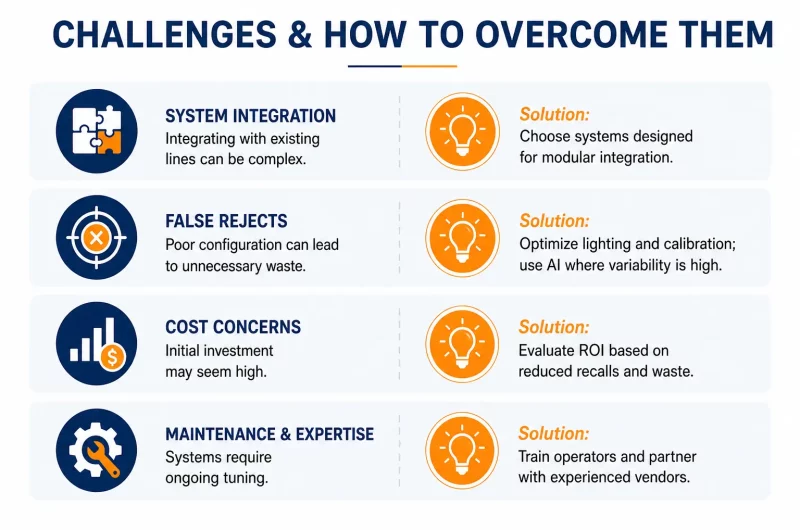
Common challenges include:

  • System Integration
    Integrating with existing lines can be complex.
    Solution: Choose systems designed for modular integration.
  • False Rejects
    Poor configuration can lead to unnecessary waste.
    Solution: Optimize lighting and calibration; use AI where variability is high.
  • Cost Concerns
    Initial investment may seem high.
    Solution: Evaluate ROI based on reduced recalls and waste.
  • Maintenance & Expertise
    Systems require ongoing tuning.
    Solution: Train operators and partner with experienced vendors.
Future Trends in Vision Systems

Future Trends in Vision Systems

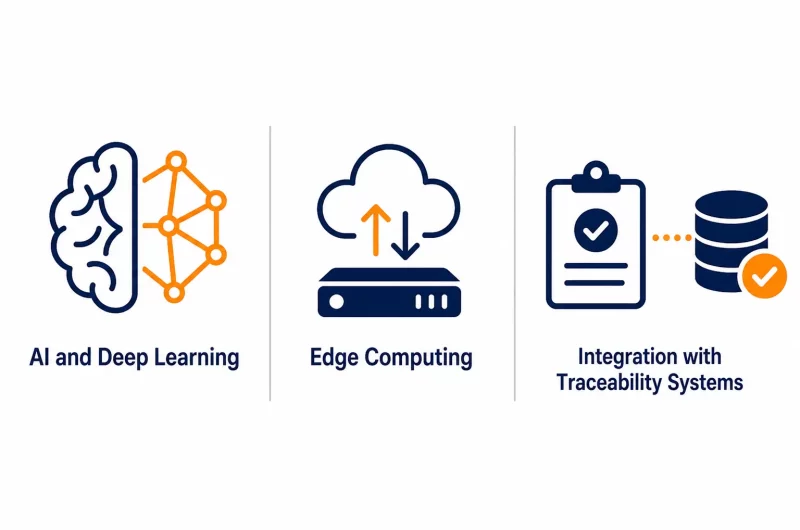
The field is evolving in three key directions:

  • AI and Deep Learning: Systems are improving at detecting subtle, non-rule-based defects.
  • Edge Computing: Faster, real-time processing directly on the production line.
  • Integration with Traceability Systems: Vision systems increasingly connect with serialization and supply chain platforms.

Example: AI-based systems can now detect cosmetic defects in tablets that were previously too subjective to automate.

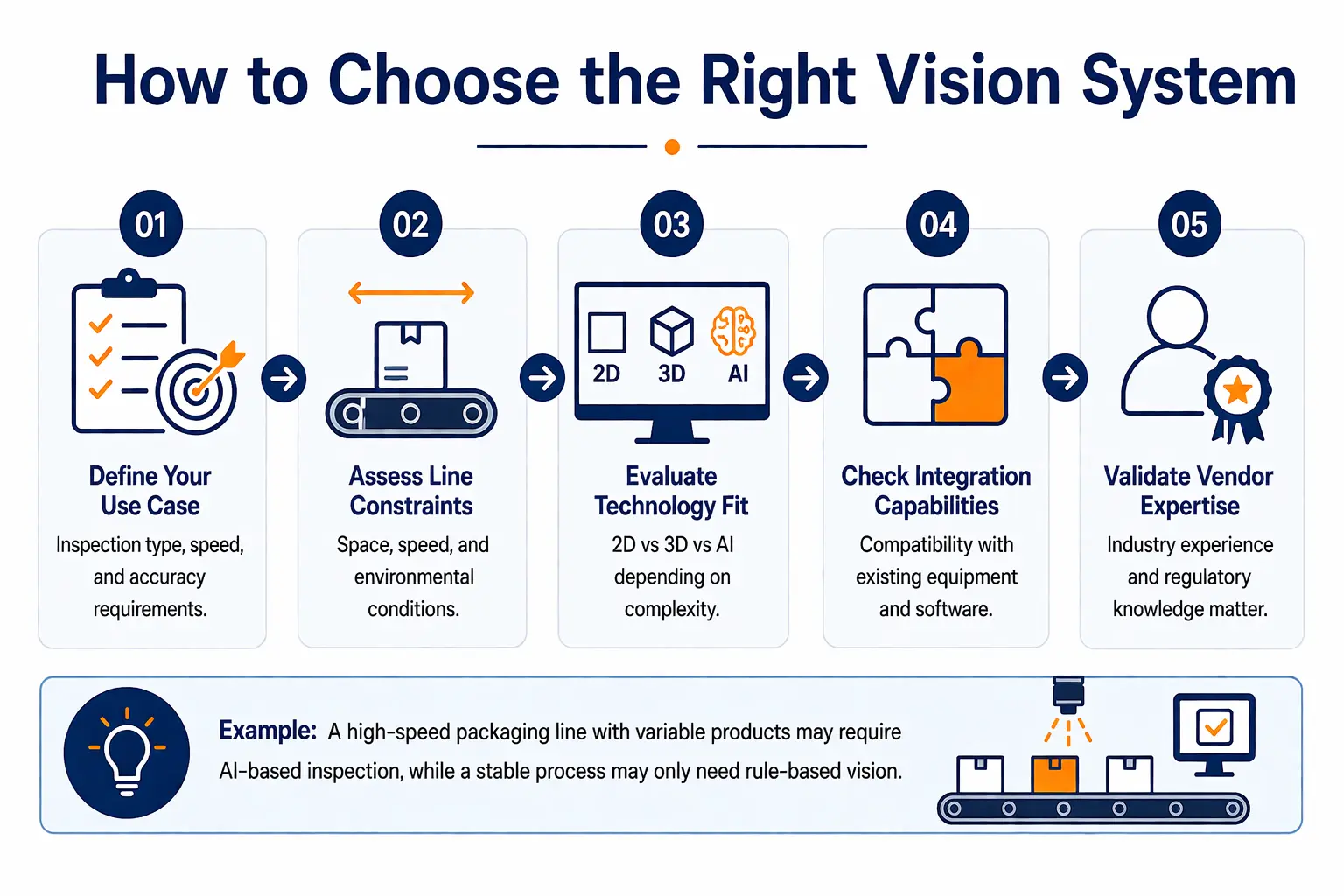
How to choose the right vision system

Why OPTEL for Vision Systems

OPTEL provides end-to-end vision solutions tailored for pharmaceutical environments:

  • Deep Pharma Expertise: Built specifically for regulated industries.
  • Integrated Traceability: Seamless connection with serialization systems.
  • Scalable Solutions: From single lines to global deployments.
  • Compliance-Ready: Designed to meet global regulatory requirements.

In practice, this means faster deployment, fewer integration issues, and systems that align with both operational and compliance needs.