
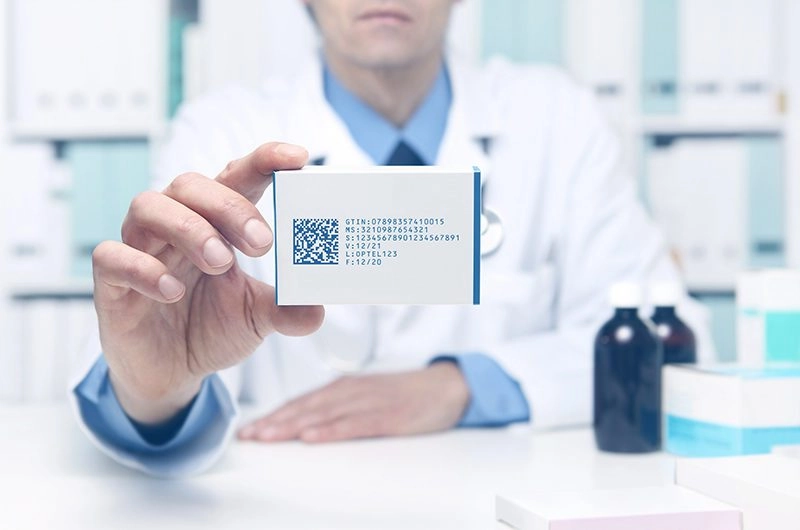
Serialization is the process of giving each individual product unit its own unique, verifiable identifier. In pharma, that means printing a serial number, GTIN, lot number and expiration date in a 2D DataMatrix on every saleable pack, so each bottle or carton can be authenticated, traced through the supply chain, and verified before it reaches a patient.

What Does “Serialization” Mean?
In packaging, serialization means assigning and applying a unique, verifiable product identifier to an individual pack. Where a standard barcode tells you what a product is, a serialized code tells you which one it is.
In the pharmaceutical industry, that identifier combines a static product code (the GTIN, which embeds the NDC in the U.S.) with a serial number that changes for every unit produced. Together they form a serialized GTIN (SGTIN), a globally unique identity for one specific pack of medicine.
Serialization was the industry’s answer to problems that batch-level coding could not solve: counterfeit drugs entering the legitimate supply chain, stolen products being resold, and recalls that had to pull back far more stock than necessary.
Serialization vs. a Batch or Lot Number
A lot number identifies a production run. A serial number identifies one unit within that run.
Take a lot of 100,000 bottles of a 30-count blood-pressure medication. Every bottle in that lot shares the same GTIN, lot number (for example, A24117) and expiration date. Without serialization, a counterfeit bottle printed with that same lot number looks identical to a genuine one.
With serialization, each bottle also carries its own serial number. The data on this exact bottle reads:
(01) 10534890157010 (17) 270630 (10) A24117 (21) 12237203824
The bottle next to it on the line has the same GTIN, expiry and lot, but ends in serial 12237203825. If serial 12237203824 is scanned at two pharmacies, or was never commissioned at the plant, the system flags it immediately. A lot of numbers alone can never do that.
How Serialization Works in Pharmaceutical Packaging
Pharmaceutical serialization runs in four steps on the packaging line: assign a number, encode it, verify it, and report it. Each step is handled by a different layer of the serialization architecture, from line devices (L1) up to corporate systems (L4).
For timelines and ownership across a full rollout, see our step-by-step guide to pharmaceutical serialization implementation.
Step 1 – Assigning a Unique Serial Number
Before a batch starts, the line receives its production data: the product’s GTIN, the lot number and the expiration date, usually from the ERP, MES or plant-level serialization software. Serial numbers are then pulled from a corporate serial number provider or generated locally, and cached at the line so production never waits on the network.
Each serial number must be unique within its GTIN and must never be reused. In some markets, such as China, serial numbers are supplied by the government rather than by the manufacturer.
Step 2 – Encoding the 2D DataMatrix
The line printer encodes the data into a GS1 2D DataMatrix on each carton, label or bottle. Each data field is introduced by a GS1 Application Identifier (AI):
- (01) GTIN
- (17) Expiration date (YYMMDD)
- (10) Batch or lot number
- (21) Serial number
The same data is also printed in human-readable form next to the code. Some markets add fields, such as Italy’s national reimbursement number (AI 716).
Step 3 – Verification and Inspection on the Line
Immediately after printing, a vision system reads every code. It confirms the DataMatrix decodes and grades it against ISO/IEC print-quality standards, then checks the human-readable text with OCR(optical character recognition )/OCV(optical character verification ) and confirms it matches the encoded data.
Any pack with a missing, unreadable or mismatched code is rejected automatically, and its serial number is decommissioned so it can never appear in the supply chain. On an OPTEL TrackSafe line, this is the role of the InspectProof vision system working with the LineMaster line controller.
Step 4 – Reporting and Chain-of-Custody Tracking
Every serial number carries a status that changes as it moves: encoded, inspected, commissioned, sampled, destroyed or shipped. Each change is recorded with a timestamp in an audit trail that supports 21 CFR Part 11 and EU Annex 11 requirements.
At the end of the batch, the line reconciles every number it uses, then sends the data up to the plant and corporate levels as EPCIS events. From there, it is shared with trading partners or uploaded to national systems such as the European Medicines Verification System (EMVS).
Why Serialization Matters for Pharmaceutical Companies
Serialization protects patients, keeps products legal to sell in regulated markets, and gives manufacturers visibility they never had with lot-level coding.
Patient Safety and Counterfeit Drug Prevention
A unique serial number lets a pharmacist or wholesaler confirm that a pack is genuine before it is dispensed. A counterfeit pack either carries a number that was never issued or duplicates one already verified, and both are caught at the point of scan. This is the core reason regulators mandated serialization.
DSCSA, EU FMD, and Global Regulatory Compliance
In the U.S., the Drug Supply Chain Security Act (DSCSA) requires a product identifier (NDC, serial number, lot and expiration date) on each package and homogeneous case, with interoperable electronic data exchange between trading partners. In Europe, the Falsified Medicines Directive (EU FMD) has required a unique identifier and anti-tampering device on every saleable pack since February 2019, verified through the EMVS. Markets including Brazil, India and Russia add their own rules, several of which also require aggregation.
Faster, More Targeted Recalls
When a quality issue is traced to specific units, serialization lets you identify exactly which packs are affected and where they were shipped. Instead of pulling an entire lot from every market, you can target the affected serial numbers and trading partners, which reduces cost, waste and drug shortages.
Supply Chain Visibility and Diversion Detection
Each time a serialized pack is shipped or received, the event is recorded. This makes it possible to see where product is in the supply chain and to spot units that appear in markets or channels they were never shipped to. Diversion, theft and reimbursement fraud all become far easier to detect.
Serialization vs. Aggregation vs. Traceability in Pharma
The three terms build on each other: serialization identifies each pack, aggregation links packs to the cases and pallets that hold them, and traceability follows all of it through the supply chain.
| Term | What it does | Pharma example |
|---|---|---|
| Serialization | Assigns a unique identifier to each saleable unit | Each carton carries its own SGTIN in a 2D DataMatrix |
| Aggregation | Records parent–child relationships between packaging levels | 48 serialized cartons are linked to one bundle, bundles to a case, cases to a pallet (SSCC) |
| Traceability (track and trace) | Records the current and past location of each unit across the supply chain | A distributor scans one pallet label and receives every carton inside it, then ships it on |
Serialization on its own proves a pack is authentic, but it does not show where the pack has been. Pharmaceutical aggregation is what makes traceability practical, since one scan of a case or pallet verifies all its contents.
Common Pharma Serialization Terms to Know
| Term | Meaning |
|---|---|
| GTIN (Global Trade Item Number) | The GS1 product identifier, static for a given product and packaging level. Combined with a serial number, it becomes an SGTIN. |
| NDC (National Drug Code) | The U.S. drug product code. It is embedded inside the GTIN on U.S. packs. |
| 2D DataMatrix | The square 2D barcode that carries the GTIN, serial number, lot and expiry on each pack. |
| EPCIS (Electronic Product Code Information Services) | The GS1 standard for sharing serialization events: what happened, when, where, why and involving whom. |
| SSCC (Serial Shipping Container Code) | The GS1 identifier is used on cases and pallets, often for mixed or partial containers. |
| L1–L4 | The serialization architecture levels: L1 line devices (printers, cameras, scanners), L2 line controller, L3 plant or site server, L4 corporate serialization and EPCIS repository. L5 is the regulator or national system. |
Serialization Beyond Pharma
If you’re not in pharma, the same principle applies: give every unit a unique identity, then use it to prove authenticity and follow the product through the supply chain. The drivers differ by industry, from device identification rules to food safety and brand protection.
- Medical devices: unique device identification (UDI) and EU MDR traceability.
- Consumer Goods: faster, targeted recalls and supply chain transparency, anti-counterfeiting, diversion control and consumer engagement.
Frequently Asked Questions
In pharma, serialization means assigning a unique serial number to every saleable pack of medicine and encoding it, with the GTIN, lot number and expiration date, in a 2D DataMatrix. This gives each pack an identity that can be verified anywhere in the supply chain.
It is used to stop counterfeit drugs reaching patients, to comply with laws such as DSCSA and EU FMD, to run faster and more targeted recalls, and to detect theft and diversion. It is also the foundation for aggregation and end-to-end traceability.
No. Serialization gives each unit a unique identity. Traceability uses that identity, plus aggregation and recorded supply chain events, to follow the unit from the packaging line to the pharmacy.
The DSCSA requires manufacturers to place a product identifier on each package and homogeneous case of prescription drugs. That identifier contains the NDC, a unique serial number, the lot number and the expiration date, in both a 2D DataMatrix and human-readable form. Trading partners must exchange this data electronically and verify product at the package level.
A barcode is the carrier; serialization is the data. A standard retail barcode holds only a product code, so every unit of that product has the same code. A serialized 2D DataMatrix adds a unique serial number, lot and expiry, so it identifies one specific pack.
Next Steps
This page covers the essentials. Our full guide goes deeper into GS1 encoding, aggregation strategy, country-by-country requirements and how to choose an L1–L4 architecture that scales with your lines.
Read the full pharmaceutical serialization guide
Ready to serialize a line or add aggregation? OPTEL’s portfolio covers every packaging level, from carton and label serialization to case and pallet aggregation, with 24/7 support.