

Estimated reading time: 8 minutes

Key Takeaways

  • Modern supply chain management revolves around visibility, traceability, and transparency to ensure efficiency and responsibility.
  • Supply chain traceability allows organizations to track products’ journeys, ensuring accountability and compliance throughout the process.
  • Visibility enables real-time insights into supply chain operations, crucial for making informed decisions and maintaining agility.
  • Transparency involves sharing verified information with stakeholders, driven by consumer demand and regulatory expectations.
  • Together, these concepts help build trust, protect brand reputation, and enhance competitive advantage in the market.

See it. Prove it. Share it. These three imperatives now define what it means to run a modern supply chain.

The last five years have been a rollercoaster for professionals in supply chain, procurement, and sourcing. Global networks stretch across multiple continents and involve countless actors, from smallholder farmers to multinational manufacturers. With this scale and complexity comes vulnerability: exposure to geopolitical and commercial disruptions, ethical and responsible sourcing challenges, and an evolving regulatory landscape.

Businesses are under growing pressure to understand, manage, and communicate how their products are sourced and produced while staying agile, competitive, and profitable.

Three interrelated concepts define this new era of responsible and efficient supply chains: visibility, traceability, and transparency. They are often mentioned together, but each plays a distinct and essential role in helping organizations build resilience, accountability, and trust.

Understanding these concepts starts with the most foundational capability: gaining clear, real-time insight into supply chain operations through visibility.

What is Supply Chain Visibility?

Supply Chain Visibility refers to the ability to access, monitor, track, and understand the status, location, condition, and flow of products, information, and resources across the entire supply chain, from raw material sourcing to final delivery to the end customer.

Why it matters

In increasingly complex and volatile supply chains, visibility has become essential to maintain control and agility. It allows organizations to detect disruptions early, coordinate across partners, and make faster, better-informed decisions. Without it, companies operate reactively, increasing the risk of delays, stockouts, and service failures.

This new era of digital visibility gives organizations both agility and foresight. Visibility has shifted from being an operational advantage to becoming a fundamental requirement for competitiveness and business continuity.

For example, a global manufacturer monitoring inbound shipments across multiple suppliers may detect a delay caused by port congestion in real time. With this level of visibility, the company can proactively reroute shipments or adjust production schedules before operations are impacted.

In an operational context, visibility goes beyond simply observing what is happening. It relies on the real-time and historical availability of accurate, relevant, and actionable data related to processes, transactions, inventory, shipments, suppliers, and distribution activities. It enables organizations to understand how their supply chain is performing as it unfolds, identify disruptions or inefficiencies, and act based on current information rather than outdated reports.

The rise of connected technologies is transforming how visibility is achieved. Companies still rely on manual updates and Excel sheets, but they now use smart sensors, standardized product identification, API, ERP systems, cloud platforms, and artificial intelligence (AI) to automatically collect the data and ensure its quality. AI driven predictive analytics can flag potential disruptions before they occur, whether caused by weather related transport delays, compliance risks, production bottlenecks, or emerging supplier issues.

Effective supply chain visibility enables organizations to:

What is Traceability?

Traceability takes visibility a step further. It refers to the ability to track and trace products, materials, and related information throughout the supply chain, linking physical product flows with structured, verifiable data. It is not just about seeing what is happening, it is about being able to prove it. 

Traceability creates a documented, auditable record of a product’s journey from origin to destination. It establishes clear relationships between batches, items, and transformations as materials move through sourcing, processing, manufacturing, and distribution. This allows organizations to reconstruct events, verify claims, and demonstrate compliance when needed. 

Why it matters

Traceability is critical whenever organizations must demonstrate accountability—whether to regulators, customers, or internal stakeholders. In the event of a quality issue, compliance audit, or reputational risk, it enables companies to quickly identify what happened, where, and why. This precision reduces operational and financial impact while strengthening trust. It is essential for compliance, audits, and risk mitigation, especially in regulated industries.

For example, a food company facing a contamination risk can use traceability data to identify the exact batches affected, trace them back to their origin, and isolate impacted products. Instead of issuing a broad recall, the company can perform a targeted intervention, reducing cost and protecting consumers more effectively.

There are two primary dimensions of traceability: 

1. Transactional Traceability (Digital/Data traceability)

Transactional traceability refers to the capture, storage, and exchange of structured data related to supply chain events and transactions. It ensures that critical information (such as product identifiers, production dates, or shipment records) is recorded and can be accessed, verified, and shared across stakeholders.

Key Components:

KDC – Key Data Criteria: These are the essential data elements required to ensure proper documentation and compliance.KDC defines what data must be captured to maintain traceability integrity. Examples: product identifiers, supplier identifiers, date of production and shipment, and more. 

CDE – Critical Data Elements: CDEs are the specific data points required to support traceability objectives, regulatory compliance, risk management, or customer requirements. Examples: Lot or batch number, production location, expiration date, shipment ID, transformation records and more. 

2. Physical Traceability (Product Traceability)

Physical traceability refers to the ability to physically identify and follow a product or material as it moves and transforms across the supply chain, using technologies such as unique identifiers, barcodes, RFID, or serialization This dimension focuses on the product itself rather than only the associated data.

Each product or component can be assigned a unique digital identity (UDI) that links it to verifiable data: where it was produced, who handled it, and under what conditions. Technologies such as immutable ledgers, 2D codes (Data Matrix), RFID, and the growing adoption of open-source databases and interoperable data-linking systems are making this process increasingly scalable and reliable.

The industry’s shift toward a unified 2D barcode standard – highlighted by initiatives such as GS1 Sunrise – will unlock significant benefits by enabling more efficient product data capture and improved visibility across supply chain flows.

  Dimension

Dimension

Transactional Traceability
Physical Traceability
Lot/Batch
Item-Level
  Focus

Focus

Data and supply chain events
Product identification and movement
Group-level tracking
Unit-level tracking
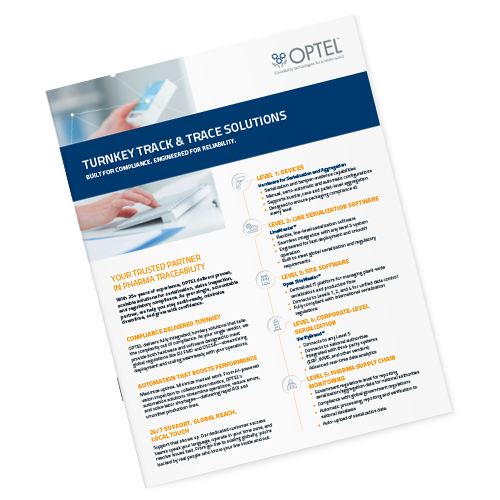
FLY_OPTEL_Industry_Pharma_EN_TIMG_500x500

Turnkey Track & Trace Solution

Download

  Purpose

Purpose

Documentation, compliance, reporting
Tracking, recalls, quality control
Efficient risk management
Maximum precision and security

Industries such as food, pharmaceuticals, chemicals, textiles, and electronics rely heavily on traceability to ensure product safety, authenticity, and regulatory compliance (such as DSCSA, FMD, Anvisa, EUDR, FSMA, PPWR and much more). In the food sector, traceability enables rapid identification of contaminated batches during recalls. In pharmaceuticals, item-level traceability ensures that each unit can be authenticated and tracked to prevent counterfeit medicines from entering the market. Chemical manufacturers use traceability to document the origin and transformation of substances for regulatory reporting and safety management. In textiles, it supports proof of origin and verifies compliance with environmental and labor standards, while in electronics it helps track components and materials throughout complex global manufacturing networks.

Traceability forms the foundation of supply chain trust. By turning operational data into verifiable evidence, traceability transforms trust from an aspiration into a measurable reality.

What is Transparency: Sharing Verified Information with Trust

Transparency is the act of sharing verified supply chain information with stakeholders, from regulators and investors to customers and the general public.

While visibility and traceability focus on generating and structuring data, transparency focuses on how that information is communicated, disclosed, and understood. It reflects a deliberate choice about what to share, with whom, and at what level of detail.

Why it matters

Expectations for transparency have increased significantly, driven by regulatory requirements, ESG considerations, and consumer demand. Companies are now expected not only to manage their supply chains but also to demonstrate their practices and impacts. Governments are implementing due diligence laws that require disclosure of sourcing practices and supply chain risks. Consumers want to know the origins of their products and their social and environmental impact. Investors are increasingly using ESG performance to assess risk and long-term value, directly influencing how companies are valued and financed. 

Transparency directly influences trust, brand reputation, and even market access.

However true transparency depends on credible data and thoughtful communication. Without traceability, shared information lacks credibility. And when transparency is superficial or unsupported, it can expose organizations to reputational risks such as greenwashing. 

For example, a fashion brand may publish information about the origin of its materials, labor conditions, and environmental footprint. When this information is supported by traceability data and verifiable certifications, it strengthens trust with consumers and investors. Without that foundation, the same claims may be questioned.

True transparency therefore requires more than disclosure. It involves:

True transparency therefore requires more than disclosure. It involves:

When done responsibly, transparency strengthens relationships and accountability. When poorly executed, it can undermine credibility.

From Data to Trust: Why All Three Matter

Visibility, traceability, and transparency are not three separate initiatives – they are three stages of the same journey. Visibility generates the data. Traceability turns that data into verifiable proof. Transparency shares that proof with the people who need to trust it.

Skip a step, and the chain breaks: transparency without traceability is just a claim. Traceability without visibility is incomplete. And visibility without transparency never reaches the people who need it most.
Organizations that master all three don’t just meet compliance requirements – they build resilience, protect brand reputation, and turn accountability into a competitive advantage.

See it. Prove it. Share it. – this is what OPTEL helps you do, at every stage of your supply chain.

Whether it’s real-time inspection on the manufacturing floor, serialization and compliance across distribution, or supplier-level traceability upstream, OPTEL’s traceability and serialization solutions give you the tools to turn data into trust.

Curious what visibility, traceability, and transparency look like in your industry? Contact Us