From Packaging Inventory to Declaration of Conformity: The PPWR Compliance Playbook

Most organisations placing packaging on the EU market already know that PPWR exists. The harder question is what it actually requires your teams to do, in what order, with what data, and by when. This guide answers those questions without generalities. It covers the specific documentation requirements in force from August 2026, the data your compliance programme cannot function without, the operational gaps that consistently block progress, and a step-by-step readiness roadmap. If you are responsible for packaging compliance, supply chain, regulatory affairs or procurement in an organisation that places packaging on the EU market, this is the practical starting point.

What is PPWR?

The EU Packaging and Packaging Waste Regulation entered into force on 11 February 2025 and begins applying from 12 August 2026. It replaces Directive 94/62/EC and its amendments.

The distinction between a directive and a regulation has direct operational consequences. A directive sets targets that Member States implement through national law, giving each country latitude over timelines, documentation requirements and enforcement. A regulation applies uniformly and simultaneously across all EU Member States without transposition. From August 2026, there are no national implementation gaps to navigate and no country-by-country grace periods to plan around.

The practical difference is visible in how compliance evidence was managed under the previous framework. EPR scheme documentation requirements varied significantly between Germany, France and Poland under Directive 94/62/EC. A producer managing three markets often maintained three separate compliance files calibrated to three different sets of national authority expectations, with no obligation to align formats. Under PPWR, the conformity documentation standard is the same across all Member States from day one: one Declaration of Conformity format, one technical file structure, one conformity assessment procedure. The volume of documentation work does not decrease, but the architecture is consistent.

PPWR covers all packaging placed on the EU market regardless of material (plastic, glass, paper, metal, composite) and regardless of the sector it originates from. Its obligations cluster around four areas: packaging design and material compliance, recyclability and recycled content, reuse and refill, and labeling and data.

The regulation is built on extended producer responsibility: the entities that place packaging or packaged products on the EU market bear the primary compliance obligations. Compliance is not delegated to packaging suppliers. It sits with the producer, importer or distributor who brings that packaging to market.

Why PPWR carries more weight than its predecessor

Three structural differences explain why PPWR creates a different kind of compliance challenge than the directive it replaces.

Market access is conditional on documentation. From August 2026, packaging placed on the EU market requires a completed EU Declaration of Conformity, full technical documentation and a conformity assessment procedure. Non-compliant packaging cannot legally be placed on the EU market after the deadline. This is not a reporting obligation with a fine attached. It is a market access condition.

EPR fees are linked to packaging data quality. EPR fee structures under PPWR are modulated based on recyclability performance. Companies that cannot substantiate recyclability or recycled content claims with validated supplier data will face higher fees and potential audit exposure. The quality of your packaging data has a direct financial consequence.

Compliance requires upstream supplier data that most organisations do not currently hold. Substance restrictions covering PFAS and heavy metals, material composition data, and recyclability evidence all require documented input from packaging suppliers. For organisations sourcing from multi-tier supply chains, this is a data collection and validation programme in its own right. Spreadsheets and fragmented systems are structurally unsuited to run it at scale.

PPWR vs the previous packaging waste regime

The previous directive (94/62/EC and its amendments) set recovery and recycling targets at the national level. Member States had significant latitude in how they designed their EPR schemes, what documentation they required from producers, and how they enforced packaging design rules. In practice, this created uneven national frameworks and compliance obligations that varied considerably by market.

PPWR restructures this at the operator level. The key differences are worth understanding precisely:

Area Directive 94/62/EC PPWR (Regulation 2025/40)
Compliance level National targets Operator-level obligations per product and packaging format
Design requirements Broad essential requirements Harmonised recyclability framework; material-specific recycled content targets; mandatory design criteria via delegated acts
Substance restrictions Not addressed at this specificity Explicit restrictions on PFAS and heavy metals; specific rules for food contact packaging
Reuse obligations No binding framework Mandatory sector-specific targets for beverage, transport and other packaging formats
Data and labeling No equivalent Harmonised sorting labels, recycled content claims, and requirements linked to EU Digital Product Passport framework
Conformity documentation Not required at packaging format level Declaration of Conformity, technical file and conformity assessment procedure mandatory per packaging format from August 2026

Who is affected and what it means operationally

PPWR applies to any economic operator that places packaging or packaged products on the EU market. Four roles carry distinct obligations. Understanding what each role is responsible for is the starting point for assigning internal ownership.

Suppliers Packaging suppliers are required to provide material declarations, substance compliance confirmations and recyclability design data to their customers. This is not optional under PPWR. Without structured supplier data, no Declaration of Conformity can be produced by the manufacturer. For organisations whose suppliers are not yet equipped to generate this documentation, building that capability into the supplier base is a prerequisite for compliance, not a later-stage concern.
Key question to ask internally:
Have we identified which of our packaging suppliers can currently provide component-level material declarations, PFAS/heavy metals confirmations and recycled content evidence in a structured format?
Manufacturers Manufacturers carry the heaviest documentation burden. They must execute conformity assessments based on upstream supplier data, maintain technical records and the Declaration of Conformity, apply physical marking and labeling, manage authority notifications and remedial actions, and calculate packaging volumes for EPR fee settlement. The practical consequence is that any packaging format without a complete and current technical file cannot be placed on the EU market from August 2026.
Key question to ask internally:
For each packaging format we place on the EU market, do we have a completed technical file that covers all requirements under Articles 15-19, and is it maintainable when formulations or suppliers change?
Importers Importers must verify and retain copies of technical files and Declarations of Conformity before placing products on the EU market. They are responsible for ensuring correct labeling compliance, overseeing corrective measures when non-conformities are identified, and submitting packaging data for EPR reporting. Importers who have historically relied on manufacturer declarations without verifying their completeness will need to review their documentation processes before the deadline.
Key question to ask internally:
Is our current process for verifying supplier Declarations of Conformity documented, repeatable and defensible to a market surveillance authority, or does it depend on individual relationships?
Distributors Distributors must validate marking, confirm producer registration status, and make Declaration of Conformity and compliance evidence available on request from market surveillance authorities. They are also responsible for aggregating packaging data for EPR reporting and monitoring corrective measures for any non-compliant units in their supply chain.
Key question to ask internally:
If a market surveillance authority requests the Declaration of Conformity and technical file for a product we distribute tomorrow, can we retrieve and provide that documentation within 24 hours?
Non-EU companies

Geographic scope is a point that frequently surprises non-EU operators. If you export packaged products into the EU, PPWR applies to your packaging. The regulation makes no distinction between EU-based and non-EU-based producers from the perspective of market access requirements. Non-EU manufacturers supplying EU distributors or retailers should expect their EU counterparts to request compliance documentation as part of their own PPWR obligations. This request is not a preference; it is a legal necessity for the importer or distributor.

Non-EU companies shipping packaged goods directly to EU consumers face an additional obligation: they must appoint an authorised representative established within the EU. This representative takes on responsibility for ensuring the packaging placed on the EU market meets PPWR requirements and can be held accountable by market surveillance authorities.

Key question to ask internally:
Have our EU importers or distributors formally requested PPWR compliance documentation from us, and if not, do we understand that they will need to do so before August 2026 to protect their own obligations?
Sectors with concentrated exposure include food and beverage, pharmaceuticals, cosmetics, e-commerce, and any industry relying on single-use plastic or composite packaging. Organisations operating across DACH, France and Central/Eastern Europe face direct compliance obligations from the first day of application.

KEY PPWR REQUIREMENTS: THREE TIERS OF OBLIGATION BY OPERATIONAL URGENCY

The requirement areas defined by PPWR carry different enforcement dates and demand different kinds of operational response. Understanding which obligations determine market access from August 2026, which require data infrastructure that takes months to build before a legal deadline arrives, and which have later cut-off dates but impose architecture decisions today is the starting point for sequencing your compliance programme. The three tiers below organise these obligations by operational urgency, not by the order they appear in the regulation.

Tier 1: Act before August 2026. Documentation, Design and EPR Registration

These are the obligations that determine market access from day one of application. No grace period applies. A packaging format that does not meet these requirements cannot legally be placed on the EU market from August 2026.

  • Conformity documentation. Each packaging format requires three mandatory documents: an EU Declaration of Conformity (Annex VIII), Technical Documentation covering material composition, substance compliance, recyclability assessment and recycled content data (Articles 15-19), and a completed Conformity Assessment Procedure (Annex VII). Without all three, the packaging format cannot be placed on the EU market.
  • Substance restrictions. Packaging must comply with PPWR restrictions on substances of concern. PFAS are subject to threshold restrictions from August 2026, with specific requirements for food contact packaging. Specific rules also apply to heavy metals. Compliance must be verified at component level and supported by supplier evidence.
  • Packaging space and minimisation: qualitative obligation from August 2026. From August 2026, sales packaging must minimise empty space while maintaining functionality. There is no specific percentage threshold for sales packaging at this date: the obligation is qualitative. The chiffré threshold for grouped, transport and e-commerce packaging (50% maximum empty space) is a 2030 requirement covered in Tier 3.
  • Reuse system infrastructure. From August 2026, economic operators must have a reuse system in place for reusable packaging formats. This is the infrastructure obligation: having a functional system available. The mandatory reuse volume targets (e.g. 10% of beverage packaging in reusable formats by 2030) are separate and apply progressively from 2030, covered in Tier 3.
  • EPR registration and reporting. Producers must register with national EPR schemes and report packaging volumes placed on the market by material, format and geography. EPR fee modulation is based on recyclability performance, creating a direct financial link between data quality and cost.

Tier 2: Build now, run continuously: data infrastructure that cannot be switched on at the last moment

These are not August 2026 compliance deadlines. The hard legal obligations on recyclability grades and recycled content targets apply from 2030. What applies from August 2026 is the documentation requirement: your technical file must include a recyclability assessment and recycled content evidence from day one. The data processes that feed those documents take six to twelve months to establish. Treating them as 2029 tasks is how organisations arrive at August 2026 with incomplete technical files and at January 2030 with no validated recyclability data.

  • Recyclability documentation for the technical file. From August 2026, the technical file required for each packaging format must include a recyclability assessment. This is not the same as meeting the recyclability grade requirements, which become a hard market access condition from 1 January 2030. What is required now is a documented evaluation of each format against the applicable harmonised criteria. When formulations, materials or suppliers change, the assessment must be updated. Formats whose recyclability is unknown cannot have a complete technical file.
  • Recycled content data collection. Mandatory minimum recycled content targets for plastic packaging apply from 1 January 2030 (30% for PET contact-sensitive, 10% for other contact-sensitive plastics, 30% for SUP beverage bottles, 35% for other plastics). The Commission implementing act defining the calculation and verification methodology is due by 31 December 2026. What is required now is establishing the chain-of-custody data flows from suppliers, so that when the methodology is published and the 2030 deadline approaches, you have years of validated data rather than months. Supplier claims without documented calculation methodology will not satisfy the obligation.
  • Supplier data maintenance. Material declarations, substance compliance confirmations and recyclability data from suppliers are not static documents. They require a process for managing updates when formulations or supply relationships change. A compliant DoC at launch that becomes outdated six months later creates retroactive audit exposure.


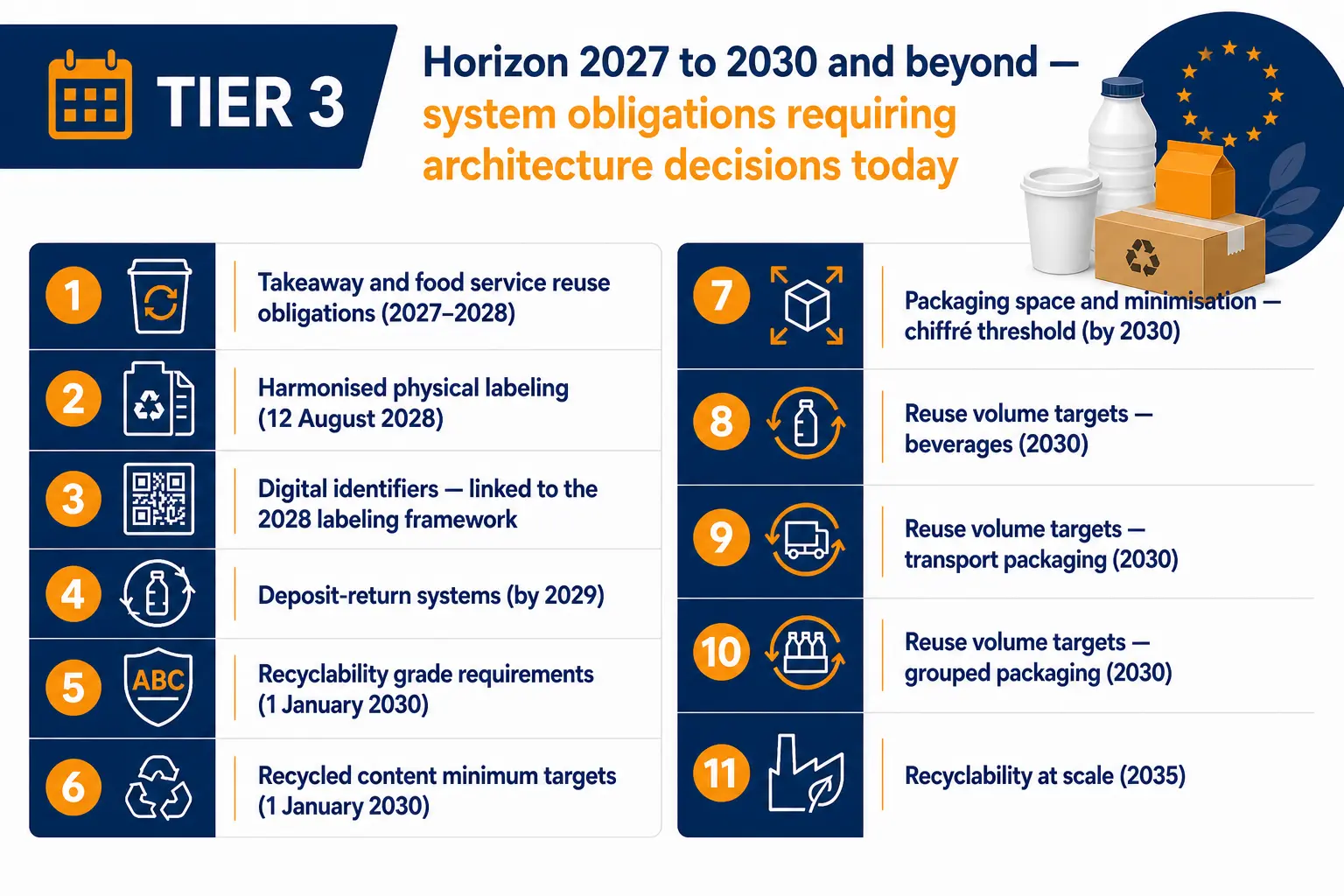
Tier 3: Horizon 2027 to 2030 and beyond: system obligations requiring architecture decisions today

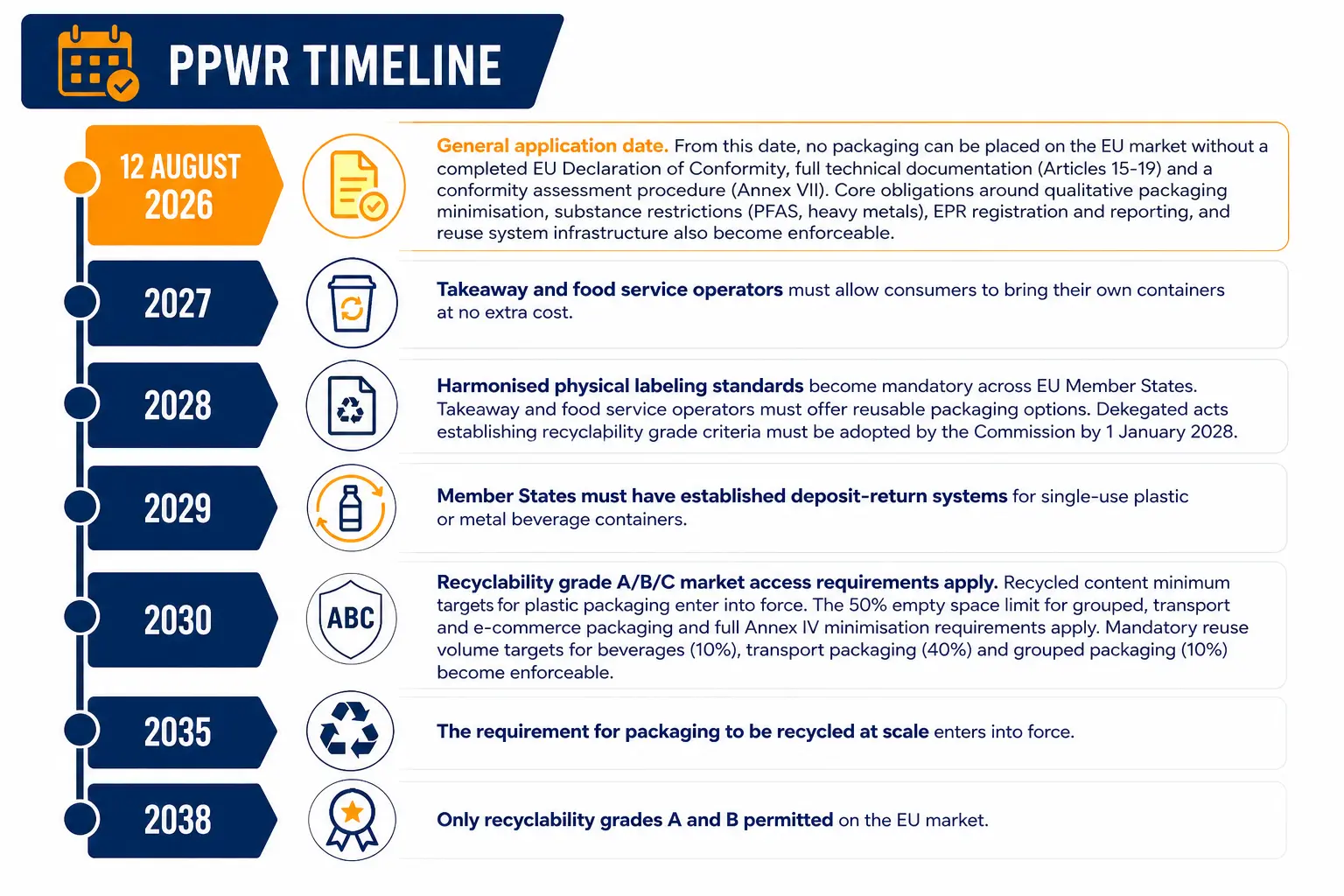
PPWR compliance timeline


These obligations have staggered enforcement dates, but the infrastructure decisions required to meet them interact directly with the Tier 1 and 2 systems you are building now. Designing those systems without accounting for Tier 3 requirements means rebuilding them later.

  • Takeaway and food service reuse obligations (2027-2028). Food service and takeaway operators must allow consumers to bring their own containers at no extra cost from 2027. From 2028, they must offer reusable packaging options for takeaway items at no extra cost. Operators in these sectors should begin supplier and logistics planning now.
  • Harmonised physical labeling (12 August 2028). Harmonised sorting labels and recycled content labels become mandatory across all EU Member States from 12 August 2028. The Commission will establish label specifications by August 2026. Packaging design and artwork workflows need to account for label update cycles before the 2028 deadline.
  • Digital identifiers, linked to the 2028 labeling framework. PPWR introduces requirements for digital identifiers, such as QR codes, linking packaging to structured product-level compliance data covering material composition, recyclability and reuse information. These requirements are connected to the labeling framework being standardised by 2028. The exact mandatory application date for digital identifiers is subject to the delegated acts being adopted by the Commission. Organisations building their packaging data infrastructure now should ensure it can support these identifiers without a full rebuild.
  • Deposit-return systems (by 2029). Member States must ensure that deposit-return systems for single-use plastic or metal beverage containers are established by 2029, unless those containers already achieve a high separate collection rate. Beverage producers should monitor national implementation timelines, as deposit-return systems affect packaging format decisions and EPR reporting structures.
  • Recyclability grade requirements (1 January 2030). From 1 January 2030, packaging may not be placed on the EU market unless it meets recyclability grade A, B or C under the harmonised framework. Delegated acts defining the grade criteria must be adopted by the Commission by 1 January 2028. From 1 January 2038, only grades A and B will be permitted. Formats in Tier 2 recyclability assessment that fall below grade C will need redesign before this deadline.
  • Recycled content minimum targets (1 January 2030). Mandatory minimum recycled content targets for plastic packaging enter into force: 30% for PET contact-sensitive packaging, 10% for other contact-sensitive plastics, 30% for SUP beverage bottles, 35% for other plastic packaging. These targets increase again for 2040. The Commission implementing act defining the calculation and verification methodology is due by 31 December 2026. Organisations that have not established chain-of-custody data flows from their recycled material suppliers by 2028 will be unable to demonstrate compliance by 2030.
  • Packaging space and minimisation: quantitative threshold (by 2030). By 2030, economic operators must ensure that grouped, transport and e-commerce packaging does not exceed 50% empty space. The complete weight and volume minimisation requirements per Annex IV also apply from 1 January 2030. These obligations interact with recyclability and recycled content redesign work already underway.
  • Reuse volume targets: beverages (2030). Beverage distributors must ensure 10% of products are offered in reusable packaging by 2030, rising to 40% by 2040. Producers already required to have reuse system infrastructure in place from August 2026 will need that infrastructure to carry the volume required by 2030.
  • Reuse volume targets: transport packaging (2030). By 2030, 40% of transport packaging must be reusable, with an aspirational target of 70% by 2040. This is a more demanding threshold than the beverage target and requires supply chain and logistics decisions that cannot be deferred to 2029.
  • Reuse volume targets: grouped packaging (2030). By 2030, 10% of grouped packaging must be reusable, with an aspirational target of 25% by 2040. Producers using grouped packaging across distribution channels should assess which formats fall under this obligation now.
  • Recyclability at scale (2035). The requirement for packaging to be recycled at scale enters into force in 2035. This is distinct from the grade requirements: grade compliance concerns packaging design and material properties assessed from 2030; the 2035 obligation concerns demonstrated recycling performance at industrial scale. Both need to be tracked in parallel.


PPWR timeline: compliance deadlines and the lead time reality

PPWR compliance timeline


The lead time problem. Building a complete packaging inventory from scratch typically takes three to six months for organisations managing more than a few hundred SKUs across multiple business units. Supplier engagement, from issuing structured data requests to receiving validated material declarations, adds another four to six months when scaled across a full supplier base. Recyclability assessments and conformity documentation require completed supplier data as a prerequisite. An organisation that begins this process in January 2026 cannot realistically reach compliance by August 2026. The programme needs to be underway now.

THE PPWR COMPLIANCE DATA MODEL: SIX CATEGORIES YOUR PROGRAMME CANNOT FUNCTION WITHOUT

1

1. Packaging Inventory

A complete, structured record of all packaging formats by SKU, including primary, secondary, transport and service packaging, with material composition and weight data at the component level. This is the master dataset from which all other compliance work is derived. Without it, no other step can proceed reliably.

Operational risk if incomplete: recyclability assessments, substance compliance checks and EPR volume calculations are all scoped against the packaging inventory. Gaps in the inventory mean gaps in compliance coverage that may not surface until an authority request arrives.

2

2. Supplier Material Declarations

Material declarations from packaging suppliers, including substance compliance confirmations for PFAS and heavy metals, recycled content percentages with calculation methodology, recyclability design criteria, and evidence supporting conformity assessments. Suppliers are required under PPWR to provide this technical information. It is not optional, and a compliant Declaration of Conformity cannot be produced without it.

Operational risk if incomplete: a DoC produced without current, validated supplier declarations exposes the manufacturer or importer to audit risk. When formulations or suppliers change, declarations must be updated. A static supplier data collection process does not satisfy this requirement.

3

3. Recyclability Assessments

A documented evaluation of each packaging format against the applicable harmonised recyclability criteria, referencing the methodology and outcome. This assessment must be repeatable and auditable; a verbal claim or a supplier statement is not sufficient.

Operational risk if incomplete: packaging formats with unknown recyclability status cannot receive a valid DoC classification and face potential market restriction from 2030 onwards. Identifying these formats now is the minimum required action.

4

4. Substance Compliance Records

Evidence that packaging meets restrictions on substances of concern, including PFAS and heavy metals, verified at the component level and retained for audit. For food contact packaging this requirement applies with particular specificity under PPWR.

Operational risk if incomplete: substance compliance cannot be asserted without component-level evidence. A market surveillance request for this documentation does not come with advance notice.

5

5. Conformity Documentation Set

For each packaging format: the EU Declaration of Conformity (Annex VIII), the full technical file (Articles 15-19) and the completed conformity assessment procedure (Annex VII). These are the legal outputs required to place packaging on the EU market from August 2026. They must be maintained and made accessible to market surveillance authorities on request. The regulation requires manufacturers and importers to retain technical documentation for five years, or ten years in the case of reusable packaging.

Operational risk if incomplete: absence of any one of these three documents means packaging cannot legally be placed on the EU market. A DoC assembled from email threads and a technical file distributed across shared drives is not audit-ready. A documentation set that cannot be retrieved within the retention period creates the same exposure as one that was never produced.

6

6. EPR Reporting Data

Volumes of packaging placed on the EU market, disaggregated by material, format and market, feeding into national EPR registration and fee calculations. EPR obligations are national, which means an organisation operating across ten EU Member States must manage ten registration and reporting frameworks, each with its own timelines and data formats, from a single consistent packaging dataset.

Operational risk if incomplete: EPR fee modulation is based on recyclability performance data. Reporting from an incomplete or unvalidated dataset leads to incorrect fee calculations and potential audit exposure.

Where PPWR compliance programmes stall: seven operational failure points

The challenges that block PPWR progress are not primarily regulatory. They are operational. Each one below describes the situation as it presents in practice, not as a generic gap.

1. The inventory that does not exist

A consumer goods company with 400 SKUs across three business units begins its PPWR assessment. Six weeks in, the team realises that no consolidated packaging inventory exists. Procurement holds component data for direct-sourced packaging. The product development team has partial specs. Several legacy SKUs exist only in supplier catalogues. Until a complete component-level inventory is built, no recyclability assessment can be scoped, no substance compliance check can be run, and no DoC can be produced. This is the foundational gap, and it is more common than most organisations expect.

2. Suppliers who cannot provide what PPWR requires

Packaging suppliers are required under PPWR to provide material declarations, substance compliance confirmations and recycled content data. Many smaller suppliers lack the internal processes to generate this documentation in a structured, auditable format. When data requests go out as email attachments and responses arrive as PDFs in inconsistent formats, procurement teams face weeks of manual reconciliation before any compliance validation can begin. The problem compounds when direct suppliers source components from upstream providers who are even less prepared.

3. Recyclability status that nobody has assessed

A manufacturer with a complex packaging portfolio knows its packaging passes visual inspection but has never run a formal recyclability assessment against harmonised criteria. Several formats contain composite materials whose recyclability is unknown. Without assessment methodology aligned to the PPWR criteria, recyclability cannot be claimed or documented, and the DoC cannot be completed. Identifying which formats require redesign before August 2026 takes time that needs to be accounted for now.

4. Recycled content claims that do not hold up to audit

A supplier states that a packaging component contains 30% post-consumer recycled content. The producer includes this in its DoC. An authority requests the substantiation. The supplier cannot provide a documented calculation methodology or verifiable chain of custody evidence. The claim fails the audit. Recycled content targets under PPWR require more than a supplier statement; they require documented calculation methodology and verifiable evidence retained at the component level.

5. Compliance documentation that exists on paper but not in practice

A regulatory team produces a Declaration of Conformity. The technical file it references is distributed across three shared drives, several team email inboxes and one retired employee’s laptop. The conformity assessment procedure was completed once and never updated when packaging formulations changed. When a market surveillance authority requests the documentation set, the team needs two weeks to locate and compile it. Market surveillance requests do not come with two weeks of notice.

6. Governance that stops at the first cross-functional handoff

PPWR touches procurement, packaging design, sustainability, regulatory affairs and finance. In most organisations, no single owner has authority across all of these functions. Packaging changes require sign-off from multiple teams. Supplier switches that affect material composition trigger compliance re-assessments that nobody is assigned to run. Without a defined decision workflow and clear ownership, compliance work stalls at every cross-functional boundary.

7. EPR complexity that multiplies with every additional Member State

An organisation placing packaging on the market in Germany, France, the Netherlands, Poland and Spain faces five separate EPR registration and reporting frameworks, each with its own timelines, data formats and national authority requirements. A consolidated, validated packaging dataset is the prerequisite for feeding all of them. Companies that maintain separate national datasets, or that report from unvalidated source data, create both fee calculation errors and audit risk.


How to build a PPWR readiness roadmap

Each failure point above has a corresponding action. The sequence matters. Skipping steps creates compounding problems that are harder to resolve the closer you get to the August 2026 deadline.

Step 1: Assess your current state

Before committing resources, understand where you actually stand. Map your packaging inventory coverage, identify supplier data gaps, flag formats with unknown recyclability, and assess your internal governance. A structured diagnostic at this stage prevents misdirected effort later.

Who can help: regulatory consulting firms with EU packaging expertise are well positioned to run this diagnostic, benchmark your exposure against PPWR obligations, and identify the highest-priority gaps.

Step complete when: You have a written inventory gap assessment, a supplier data readiness score by tier, a list of formats with unknown recyclability, and an identified owner for the PPWR programme.

Step 2: Establish governance

Assign ownership across Procurement, Packaging, Sustainability, Regulatory and IT. Define who approves packaging changes and supplier switches. Update procurement policies to include PPWR-relevant criteria covering controlled substances, material reduction and design for recyclability.

Who can help: legal advisors and consulting firms familiar with EU product regulation can help define accountability frameworks and align your governance model with what market surveillance authorities will expect.

Step complete when: A RACI or equivalent document exists that covers packaging change approval, supplier switch decisions, DoC maintenance and EPR reporting responsibility. Procurement policy has been updated.

Step 3: Build your packaging inventory

Start with your highest-volume SKUs. Collect component-level material and weight data. Document format classifications across primary, secondary, transport and service packaging. This inventory is the master dataset from which all other compliance work is derived, including the technical documentation required under Articles 15-19.

Who can help: Optchain is well suited to this step for organisations managing packaging across multiple business units, regions or ERP systems. The platform centralises packaging inventory data at the component level, captures material and weight information from multiple sources, and structures it in a format that feeds directly into the technical documentation required under Articles 15-19. For teams currently working from fragmented spreadsheets and shared drives, this is where a significant part of the manual workload is absorbed.

Step complete when: 100% of packaging formats in scope have a component-level record with material type, weight, and format classification. No SKU exists without a corresponding packaging entry.

Step 4: Engage your suppliers

Issue structured data requests to your packaging suppliers for material declarations, substance compliance confirmations covering PFAS and heavy metals, and recycled content evidence. Build compliance clauses into supplier contracts. Plan for multi-tier engagement where direct suppliers source components from upstream providers.

Who can help: supplier engagement at scale is where many PPWR programmes stall. Optchain structures this process through standardised data request templates and direct supplier input workflows, so that material declarations, substance compliance confirmations, and recycled content evidence arrive in a consistent, validated format rather than as unstructured email attachments. The platform tracks response status across the supplier base and flags missing or incomplete fields, giving procurement and regulatory teams a clear view of where gaps remain.

Step complete when: All Tier 1 suppliers have returned validated material declarations with PFAS/heavy metals confirmations. Response rates and outstanding gaps are tracked in a single view. Compliance clauses have been inserted or flagged for contract renewal.

Step 5: Assess recyclability and recycled content

Evaluate each packaging format against the applicable harmonised recyclability criteria. Flag formats that require redesign or substitution before August 2026. Validate recycled content data and document the calculation methodology. Treat formats with unknown recyclability status as a priority risk.

Who can help: Optchain automates the capture and documentation of recyclability assessments and recycled content data, including the calculation methodology required to substantiate claims. The platform identifies which PPWR obligations apply to each packaging format based on type and market, so that assessments are scoped against the right criteria from the outset.

Step complete when: Every packaging format has a recyclability status: compliant, requires redesign, or under assessment with a target date. No format has an unknown status. Recycled content claims are supported by calculation methodology at the component level.

Step 6: Address substance compliance

Confirm PFAS and heavy metals compliance for food contact packaging and all other applicable formats. Validate compliance with other applicable substance restrictions under PPWR. Archive supplier evidence at the component level.

Who can help: Optchain tracks restricted substances at the component level across the supplier base and archives the evidence required to substantiate compliance. For food contact packaging subject to PFAS and heavy metals restrictions, the documentation trail is maintained continuously and is accessible on demand.

Step complete when: Component-level substance compliance evidence has been received and archived for all formats in scope. Food contact packaging PFAS and heavy metals records are retrievable within one business day.

Step 7: Prepare conformity documentation, reporting and market surveillance readiness

This is the legal output required to place packaging on the EU market from August 2026. For each packaging format, produce the EU Declaration of Conformity (Annex VIII), complete the technical file as defined in Articles 15-19, and finalise the Conformity Assessment Procedure (Annex VII). Align EPR reporting data with national registration requirements across all relevant Member States.

Who can help: Optchain generates Declarations of Conformity automatically from the validated packaging dataset, maintains a centralised audit trail, and produces EPR reporting exports structured for national authority submission. Because the same dataset feeds other EU regulatory reporting requirements, organisations avoid rebuilding their compliance evidence base for each framework separately.

Step complete when: A complete DoC, technical file and conformity assessment procedure exists for every packaging format placed on the EU market. EPR registration is confirmed in all relevant Member States. A documented response process exists for market surveillance authority requests.

FAQ