
Why Are Companies Looking for a TraceLink Alternative?

If you’re evaluating TraceLink alternatives for pharma serialization, here are the top 9 options. TraceLink is a major player in pharmaceutical serialization and track and trace solutions, with a powerful, unmatched network. TraceLink remains a popular choice. However, several other solution providers are gaining visibility in 2026 and deserve to be considered as alternative platforms.

This guide presents a curated selection of leading track and trace platforms that help you comply with DSCSA, EU FMD, and other applicable regulations while aligning with your operational and technical needs. For each solution, we provide insights into the types of organizations and use cases it best supports, key features and available pricing information, and the migration pathways for transitioning your existing data from one platform to another.

8 Tracelink competitors and alternatives

VerifyBrand by OPTEL – Track and Trace Platform for Pharma Serialization

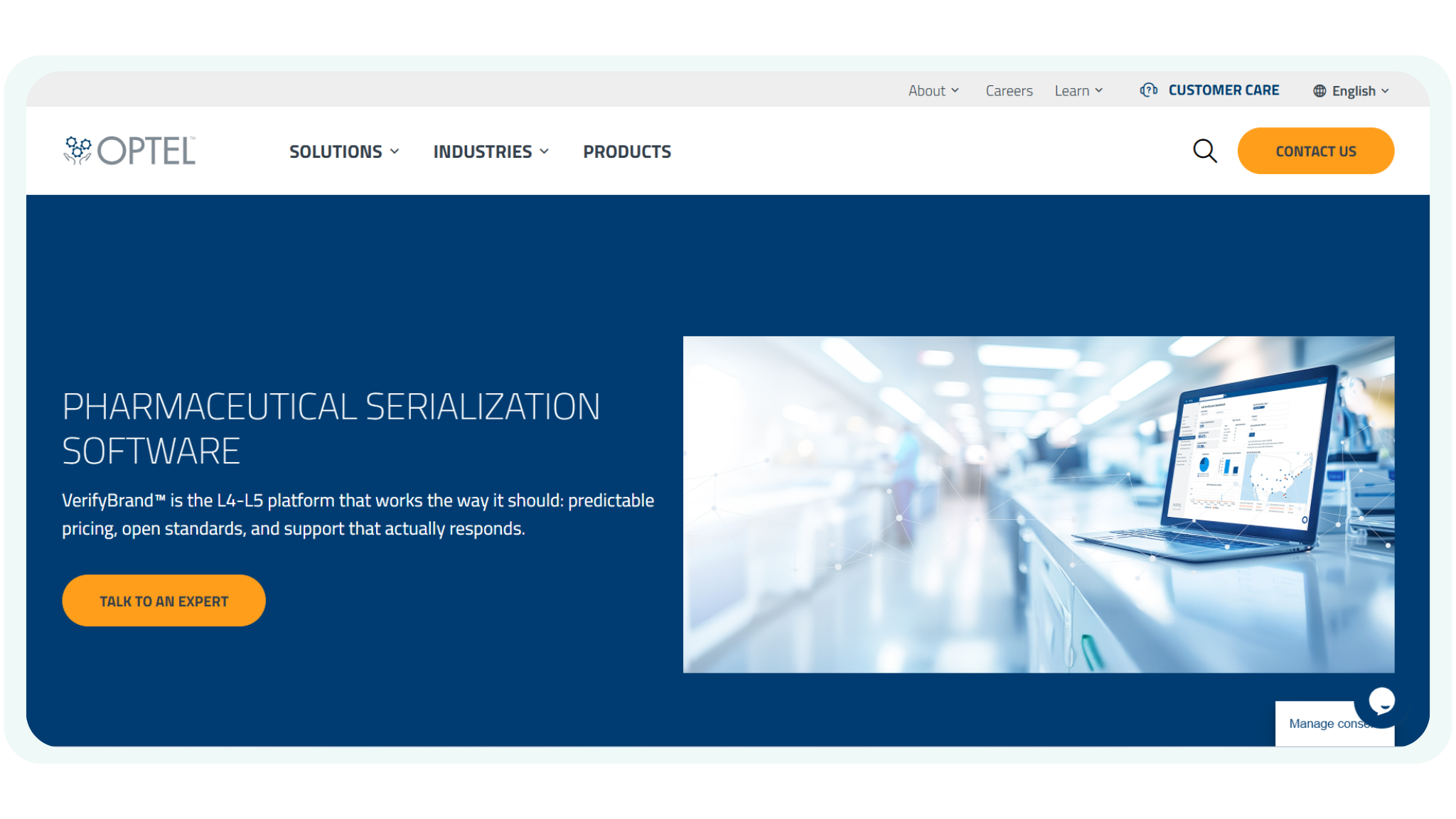
VerifyBrand is a serialization and track-and-trace platform designed for pharmaceutical teams. It is built with a focus on user experience and supports organizations that prefer to manage serialization operations internally. The platform offers an L4-L5 compliance scope, GS1 EPCIS-centric data exchange, and fixed-cost pricing with unlimited serials. Available pricing information and customer feedback indicate that VerifyBrand may be a cost-effective option for some users. VerifyBrand is offered with a global support program that includes 2-hour SLA.
 

Key features

  • SOC 2 Type II Certified – Ensures a high level of data security and operational reliability.
  • Fixed-Cost Pricing with Unlimited Serials – A pricing model that does not apply per-serial charges, intended to support predictable budgeting.
  • Global Compliance & GS1 EPCIS Only – Designed to support compliance with DSCSA, EU FMD, and other global regulatory requirements, the platform uses GS1 EPCIS standards to promote regulatory alignment across multiple markets. This approach enhances interoperability with partners, authorities, and other systems, supports flexibility for future migrations or technological changes, and reduces reliance on any single vendor over time.
  • Complete Validation & Modular Architecture – Designed to enable end-to-end system validation (including partner connections) with a modular, scalable design that lets you activate only the components you need (e.g., UID, track-and-trace, EPCIS).
  • Advanced Exception Handling & Flexible Serialization – Capabilities to manage business events, including handling shipment exceptions, to support continuity of operations.
  • Deep Integrations, Connectivity & Support – The platform is designed with a range of integrations and connectivity options to work with widely used enterprise systems and serialization environments, ERPs/WMS (SAP, Oracle, Microsoft, etc.), along with a support program intended to assist customers as needed (24/7 support with a 2-hour SLA).
  • Full-stack serialization across L1-L5 – OPTEL offers a comprehensive range of serialization and aggregation capabilities, including hardware, AI-powered vision inspection systems, site-level software, and L4/L5 track-and-trace and regulatory solutions, to support organizations seeking an integrated approach from packaging line operations to enterprise compliance and reporting.

“Now, the company can manage serialization independently, which is a huge step forward.”

Scott Pugh
Expert Consultant in Product Serialization and Supply Chain Traceability
Jennason
Access the case study

Migrating to VerifyBrand

VerifyBrand offers a structured migration process that has been used by a range of customers transitioning their serialization workflows. If you are considering a change, please contact our team to discuss your specific situation and learn about potential migration options and offers that may be available.

Pricing

Among the alternatives in this guide, VerifyBrand is the only L4-L5 platform that combines fixed-cost pricing, unlimited serials, and a published 2-hour SLA. It uses a fixed-cost mode which makes budgeting simple over time.

How to switch to VerifyBrand

SAP Advanced Track and Trace for Pharmaceuticals (SAP ATTP)

SAP Advanced Track and Trace for Pharmaceuticals (SAP ATTP) helps life sciences companies support compliance with country-specific serialization and traceability regulations by providing a corporate serialization repository, serial number management, and functions for regulatory reporting. It supports global serialization needs and can handle large volumes of serialization data.

SAP ATTP supports integration of master data and transactional data to help connect serialization processes with ERP and warehouse operations.

Key features

  • Corporate serialization repository – Maintains a centralized repository for serialization data.
  • Serial number management – Supports serial number management processes used in serialization programs.
  • Regulatory reporting – Provides capabilities to support regulatory reporting needs for serialization and traceability requirements.
  • Country-specific compliance content – Provides country-specific content/packages to help address local regulations and reporting needs.
  • Data Cockpit – Provides search, display, and maintenance functions for objects such as master data, serial number management, and repository content, with context-based navigation and application logging.
  • Serialization operations (examples) – Supports functions used in serialization operations, including commissioning, aggregation/disaggregation, and decommissioning.

Migrating to SAP

Transitioning to SAP ATTP typically involves an enterprise-scale implementation process. This process is generally conducted in collaboration with SAP professional services or a certified SAP system-integration partner to define the project scope and technical design.

Pricing

SAP ATTP is offered as an enterprise solution, with pricing determined on a case-by-case basis. It is typically licensed as an integrated add-on within a broader SAP S/4HANA or SAP ERP environment.

UniTrace by Systech

Systech’s UniTrace is a cloud-based serialization, traceability, and authentication platform that connects data across manufacturing, distribution, and dispensing. It integrates EPCIS-based traceability with exception handling and optional product-authentication technology such as UniSecure,  which utilizes existing barcodes. 

The UniTrace platform is often selected by organizations seeking a combined stack for regulatory compliance and brand protection. Its implementation typically follows an integrated project model, which may be suitable for companies requiring combined serialization and authentication capabilities.

Key features

  • End-to-end traceability platform – A cloud-hosted solution that enables tracking of serialized products across various points in the supply chain, including manufacturers, contract packagers, distributors, logistics providers, and dispensers.
  • Standards-based data exchange – Designed to support data sharing using EPCIS and GS1-style standards for serialized event exchange, with capabilities intended to assist organizations in meeting DSCSA, EU FMD, and other global traceability requirements.
  • Exception management & data quality tools – Functions intended to help identify and address errors in serialized data to support ongoing shipment processing and compliance activities.
  • Product authentication & brand protection – Optional modules, such as UniSecure, are available to add product authentication and diversion monitoring features in addition to core serialization capabilities.
  • Integration with existing systems – Designed with connectivity options to work with existing serialization setups, production line systems, and enterprise applications.
  • Modular portfolio – Organizations can implement traceability functionality first and add additional capabilities, such as authentication or other modules, as their needs evolve.

Migrating to Systech

Systech provides support services to assist organizations in transitioning serialization data and related processes into the UniTrace platform. Typical engagements  involve onboarding serialized and master data into UniTrace, aligning existing production lines and partner connections, and configuring integrations and exception handling according to customer requirements with the support of Systech’s professional services.

Pricing

UniTrace is offered on a quote-based model, and costs vary depending on factors such as the selection of modules  (e.g., core traceability only versus traceability with authentication), the number of sites and partners involved, and the overall scope of implementation and services requested.

SATT Platform by SoftGroup

SoftGroup’s SATT PLATFORM is a cloud-based serialization that provides centralized serial number management, aggregation data, and regulatory reporting for EU FMD, DSCSA, and various national hubs. The platform is designed as a configurable solution for organizations with diverse market footprints requiring specific technical tailoring.

Key features

  • End-to-end serialization, aggregation & traceability – Manages serial and aggregation number generation, alongside factory-level operations and supply chain visibility. Global compliance – Supports EU FMD, US DSCSA and a wide set of regional systems such as EMVO, Tatmeen, Asl Belgisi, IS MPT, ANVISA, NMPA and others, with automated reporting features 
  • Integrated software and hardware – SoftGroup offers a range of line and site controllers, communication software, and hardware for users seeking a single-vendor infrastructure.
  • 24/7 European-Based Support – Dedicated 24/7 support from a European support center with minimum response time and extended maintenance services, backed by over 20 years of Track & Trace expertise.
  • Deep Integration with ERP, WMS & MES – Enables secure and efficient real-time data exchange with key business platforms (ERP, WMS, MES) using standardized data models and API-driven connectivity, plus GS1 EPCIS compliance for structured, interoperable communication.

Migrating to SoftGroup SATT PLATFORM

You’ll work with SoftGroup to onboard your serialization and aggregation data, reconnect national systems and partners, and integrate SATT PLATFORM with your existing lines and ERP/WMS/MES landscape.

Pricing

SoftGroup doesn’t publish list pricing for SATT PLATFORM; it’s a quote-based SaaS offering. Your final cost will depend on which modules you use (serialization, aggregation, hub gateways, etc.), how many sites and lines you have, and how many markets you need to support.

rfxcel by Antares Vision Group

Antares Vision Group’s rfxcel Traceability System is an L4 serialization and traceability platform for pharma and life sciences. The solution includes tools intended to support supply chain visibility, assistance with applicable regulatory reporting requirements, and options for monitoring environmental conditions. rfxcel is offered with configurable components and hardware connectivity options to support different deployment needs. 

Key features

  • Enterprise traceability & compliance platform – A software platform intended to support serialization, track-and-trace processes, regulatory reporting requirements, and supply chain visibility across life sciences and other regulated industries.
  • Global, high-volume serialization engine – An L4 platform designed to handle large volumes of unique product identities and to meet serialization requirements in multiple markets.
  • Real-time data exchange across the supply chain – Capabilities to enable sharing of serialization and related data between production sites, warehouses, carriers, and applicable regulatory systems to inform visibility.
  • Open protocols & industry standards – Uses open data exchange protocols and GS1-style standards (including EPCIS) to support interoperability with external regulatory platforms and partners.
  • Modular, multi-industry DIAMIND ecosystem – rfxcel operates within Antares Vision’s DIAMIND ecosystem, offering traceability components alongside inspection systems and data-management tools for complex, multi-site programs.

Migrating to rfxcel

rfxcel provides a structured migration path to its Traceability System. The process involves coordination with their professional services team to plan and execute the transition.

Pricing

Antares Vision Group utilizes a quote-based model for its enterprise traceability stack. Total costs are determined by specific operational variables, including the selection of modules (such as serialization repository or environmental monitoring), the number of sites and geographic markets involved, and the complexity of required system integrations

AuthentiTrack by Covectra

Covectra’s AuthentiTrack platform is a single-source serialization and track-and-trace solution that combines an EPCIS-certified cloud repository with DSCSA and EU FMD capabilities, plus optional brand-protection tools. Covectra is a single-vendor alternative for companies that are comfortable with a larger, engineering-heavy program rather than a lean, fixed-cost L4-only SaaS.

Key features

  • Cloud-hosted, EPCIS-certified repository – Cloud serialization database and gateway with an EPCIS-certified backend that can integrate with virtually any packaging-line serialization system.
  • DSCSA & EU FMD compliance and traceability – DSCSA solutions at scale (securing billions of serials) plus support for EU FMD and broader supply-chain traceability.
  • Hardware + engineering services – Option to use Covectra’s own controllers and packaging-line equipment (vision systems, scanners, printers, conveyors) together with full engineering services for implementation and validation.
  • Brand protection & product authentication – Extended product-authentication tools for dose-level serialization and anti-counterfeiting across pharma and other regulated industries.
  • Analytics, recall & investigation support – Track-and-trace software designed to support recalls, investigations, and DSCSA readiness by giving secure access to event histories and aggregated serialization data.
  • Single-source L1-L5 serialization – AuthentiTrack is marketed as a complete serialization solution from the packaging line to the cloud, securing and managing products across the full pharma supply chain.

Migrating to Covectra

A typical migration involves onboarding serialized and master data into AuthentiTrack, reconnecting packaging lines and trading partners to the new platform, and validating the end-to-end solution with Covectra’s services team.

Pricing

Covectra does not publish pricing for AuthentiTrack; it’s offered as an enterprise serialization and track-and-trace solution, so you’ll need to request a quote. Total cost will depend on which components you use (cloud repository, DSCSA/EU FMD modules, product authentication, hardware, services), how many sites and lines you have, and the scope of implementation and validation work.

mytracekey PHARMA by tracekey

tracekey’s mytracekey PHARMA is aimed primarily at small and mid-sized pharma companies and MAHs that need to meet EU FMD and other key regulations without building a big in-house serialization team. It runs in a shared “Community Cloud” with standardized best practices, validation docs, and audit trails.

Key features

  • Cloud-based L4/L5 SaaS (Community Cloud): mytracekey PHARMA is a fully cloud-hosted Level 4/5 serialization service with standardized best practices for fast implementation and simple day-to-day use.
  • Global compliance with strong EU focus: Supports major regulations such as EU-FMD, MDR, DSCSA and Russia’s Markirovka, with ongoing updates to keep customers aligned with new markets and rule changes.
  • Built for SMEs + Business Process Outsourcing (TKSM): Designed as a full-service solution for SMEs: tracekey can partially or fully operate serialization on your behalf via tracekey Serialization Manager (TKSM) and related BPO offerings.
  • Connectors to lines and other providers: As a Level 4/5 provider, tracekey connects to L2/L3 systems and to “all common serialization providers,” letting you use it as a main or second-source L4 platform without replacing existing line or site systems.
  • Validation documentation, audit trails & support: mytracekey comes with validation docs, audit trails, and a customer success team that emphasizes close, ongoing support and usability improvements.
  • Modular add-ons (ALERTS, HospitalDirect, etc.): Additional services like mytracekey ALERTS (EU FMD alert management) and HospitalDirect (consolidated shipment data for hospitals) support specific EU workflows on top of the core serialization platform.

Migrating to tracekey

You’ll work with tracekey’s team to onboard product and master data, set up connections to hubs and partners, and cut over to the Community Cloud using their standardized onboarding and validation package.

Pricing

tracekey doesn’t publish list pricing for mytracekey PHARMA. It’s sold as a SaaS solution tailored to SMEs, often combined with optional Business Process Outsourcing (TKSM) or managed-services-style support, so pricing is quote-based and depends on your role (MAH, CMO, etc.), volumes, and which services you use.

OneScan by LSPedia

LSPedia’s OneScan Suite is a cloud-based serialization and compliance platform designed for the pharmaceutical supply chain, with support for DSCSA requirements and global track-and-trace reporting. OneScan provides capabilities for handling EPCIS, VRS, and exception management across serialization workflows.

Key features

  • Cloud-Based EPCIS & DSCSA Platform – A cloud-hosted platform that serves as a central hub for serialized data exchange (such as commissioning, shipping, receiving, and returns) with trading partners in the pharmaceutical supply chain. DSCSA-Aligned Workflows  – Workflows designed to align with DSCSA requirements for manufacturers, wholesalers, and dispensers in the U.S. market.
  • Verification Router Service (VRS) – A service that supports single-scan product verification and automated routing of verification requests under DSCSA.
  • Exception Management (OneScan Investigator) – Tools intended to help identify, investigate, and address EPCIS/VRS events and exceptions.
  • Role-Specific Applications – Applications developed for various stakeholders (such as healthcare providers and pharmacies) with workflows aimed at supporting their operational needs.ERP & WMS Integrations –.Connectivity options intended to work with existing enterprise resource planning (ERP) and warehouse management systems (WMS) to support data exchange and reduce manual reconciliation.

Migrating to LSPedia

LSPedia provides support for organizations moving serialization data and related processes to the OneScan platform, including onboarding of EPCIS and master data. Interested parties can contact LSPedia for more information on their migration approach.

Pricing

LSPedia doesn’t publish pricing for OneScan; it’s a quote-based enterprise DSCSA platform. Your cost will depend on which modules you need (EPCIS, VRS, Investigator, Exchange, Pharmacy Pro, etc.), the customer’s role in the supply chain, and transaction volumes.

“Build & extend” approach: customizing your existing ERP/WMS

The “build & extend” approach means you don’t buy a dedicated serialization network at all – you extend your existing ERP, WMS, or integration stack (SAP, Oracle, Microsoft, etc.) with serialization, EPCIS, and compliance capabilities. This can work well for organizations with strong internal IT/CSV teams that want everything to live in their core systems and are willing to own more of the design, build, and maintenance themselves.

Compared to a productized L4 platform, the build & extend route offers maximum control but usually comes with longer timelines, heavier validation effort, and higher dependency on internal resources. You’re not just configuring software; you’re effectively becoming your own serialization vendor.

Key features

  • Native fit with your core stack: Serialization, EPCIS messaging, and compliance reporting are implemented directly on top of your existing ERP/WMS/MES and middleware, so data and processes stay in one ecosystem.
  • High flexibility & customization: You can design workflows, data structures, and interfaces exactly the way your business operates—at the cost of more design, build, and testing work.
  • Single-vendor / reduced platform sprawl: Fewer standalone systems to manage; you extend platforms (like SAP ATTP, custom integration hubs, or WMS add-ons) you already license and govern.
  • Deep internal ownership: Your own IT, QA, and CSV teams own the architecture, implementation, and change management—no black-box vendor, but also no one to “just handle it” for you.
  • Potential long-term cost optimization at scale: For very large organizations, spreading serialization and compliance across existing licenses and teams can look attractive—once the initial build and validation are done.
  • Higher change-management overhead: Every new market, regulation change, or partner integration becomes another internal project, rather than a vendor release or configuration change.

Migrating to a build-&-extend model

If you move to a build-&-extend approach, you’re essentially doing a full re-platforming rather than a simple vendor swap. Your teams (often with help from a system integrator) will:

  • Design how serialization and EPCIS flows should look inside your ERP/WMS/integration layer
  • Migrate or re-establish serialized and master data in your new structures
  • Stand up interfaces to partners, hubs, and downstream systems
  • Run full testing and CSV/validation cycles
  • It’s a viable path if you want full control and already have a mature SAP/Oracle/Microsoft or similar stack—but it’s rarely a quick or lightweight migration.

Pricing

There’s no simple price tag for the build-&-extend option. Instead of a clear subscription for a serialization platform, your costs are spread across:

  • Additional ERP/WMS/licensing or modules (where needed)
  • System integrator / consulting projects to design and build the solution
  • Internal IT and QA/CSV capacity to implement and maintain it
  • Ongoing project work every time regulations or business requirements change

For some large enterprises, this can make sense over a long horizon, but compared to a fixed-cost L4 SaaS, the total cost of ownership is more variable and heavily dependent on how disciplined your projects and governance are.

Core Features & Support Comparison

This section gives a high-level view of how the TraceLink alternative vendors compare for the pharmaceutical supply chain — compare on features, and support, drawing on the detailed breakdowns from earlier in the article.

Platform / Vendor Best for Compliance focus Pricing model Implementation complexity Support model
VerifyBrand (OPTEL Group) Pharma manufacturers wanting a simple SaaS with strong control & transparency DSCSA, EU FMD and broader global compliance, using GS1 EPCIS Fixed-cost, unlimited serials, no hidden fees Lightweight; validation included; designed to be run in-house without expensive consultants 24/7 global support, 2-hour SLA; very low ticket volume thanks to platform stability
SAP ATTP Companies heavily invested in SAP S/4HANA / ERP / EWM DSCSA, EU FMD and country packs SAP enterprise add-on licensing; quote-based Complex; typically requires SAP or SI partner and substantial CSV Standard SAP product support; day-to-day help mainly from your SAP SI / internal SAP team
UniTrace (Systech) Manufacturers and brands that want regulatory traceability plus strong product authentication/anti-counterfeiting in one platform DSCSA, EU FMD and broader global traceability, with added brand-protection capabilities Quote-based enterprise platform; depends on modules, sites, partners, and any optional components Medium–heavy; project-style rollout with integration work and, if used, authentication setup; best with an internal tech/QA owner Enterprise support backed by Systech’s professional services for implementation, integrations, and ongoing enhancements
SATT Platform (SoftGroup) Manufacturers/CMOs with multi-market complexity and tailored config needs EU FMD, DSCSA and many regional hubs Quote-based SaaS Medium–heavy; project-style rollout with strong configuration & integration work Vendor-led support with implementation and engineering services, especially when equipment is involved
rfxcel (Antares Vision Group) Large, complex global programs needing deep configurability & visibility DSCSA, EU FMD and global markets Quote-based enterprise traceability stack Heavy; full implementation and integration; best with dedicated IT/CSV teams Enterprise support plus professional services; ongoing changes often handled as projects
AuthentiTrack (Covectra) Companies wanting a single vendor from line to cloud plus brand protection DSCSA, EU FMD, traceability and authentication Quote-based enterprise solution Medium–heavy; especially if adopting both hardware and software Enterprise support plus engineering-heavy services for lines, validation, recalls and investigations
mytracekey PHARMA (tracekey) Small & mid-sized, EU-centric pharma / MAHs wanting a full-service SaaS Strong EU FMD focus, with MDR, DSCSA and other markets Quote-based SaaS, often with BPO add-ons Lighter tech lift but service-heavy; provider can operate processes for you High-touch support for SMEs; can extend into BPO (TKSM) where tracekey runs parts of serialization
OneScan (LSPedia) U.S. DSCSA-focused manufacturers, wholesalers & dispensers DSCSA first, with some global track-and-trace Quote-based enterprise SaaS; depends on modules & volume Medium; guided onboarding and migrations with LSPedia team Enterprise support focused on DSCSA, EPCIS and VRS; ticket-based with project help for migrations
Build & extend (ERP/WMS) Very large orgs with strong internal IT/CSV Whatever you build: DSCSA, EU FMD and more via custom work No simple list price; cost = licenses + SI + internal time Heaviest; you design, build, validate and maintain everything No dedicated serialization vendor support; you rely on internal teams and system integrators

Next steps

Choosing a TraceLink alternative isn’t just about matching a feature checklist. It’s about finding a platform that fits how your team works, how much complexity you want to own, and how predictable you want your costs to be over the next 5-10 years. If you’re looking for an L4-L5 serialization solution that supports global compliance, uses GS1 EPCIS only (no proprietary formats), and comes with fixed-cost pricing and a 2-hour SLA, VerifyBrand is worth putting at the top of your shortlist.


Sources