
Visionner la discussion complète avec nos experts

L’application de la DSCSA a changé quelque chose que la plupart des équipes n’avaient pas anticipé : elle n’a pas seulement relevé la barre de la conformité, elle a redéfini ce que « logiciel fonctionnel » signifie réellement dans les opérations quotidiennes.

Avant l’application, l’objectif était clair. Se mettre en conformité. Cocher la case.

Mais l’application a renversé le critère d’évaluation. Les équipes qui ont respecté l’échéance se retrouvent aujourd’hui avec des systèmes qui fonctionnent techniquement et se demandent discrètement s’ils fonctionnent assez bien.

Ce guide s’adresse à ces équipes.

Qu’est-ce qui a changé après l’application de la DSCSA ?

Le changement est simple, mais facile à sous-estimer. Avant l’application, votre plateforme de sérialisation était évaluée sur sa mise en œuvre : Peut-elle vous rendre conforme ? Pouvez-vous aller en ligne à temps ?

Avec l’application, l’évaluation est opérationnelle : Votre équipe peut-elle travailler au quotidien sans que cela devienne un fardeau ?

Ce sont deux questions différentes. Un système peut réussir le premier test et échouer le second.

La « nouvelle normalité » sous application signifie que les exceptions ne sont plus hypothétiques. Produit sans données. Données sans produit. Non-concordances de données maîtresses. Marchandises endommagées. Erreurs de séquence. Non-conformité d’étiquetage. Ce ne sont pas des cas limites. Ce sont des problèmes du mardi matin. La question est de savoir à quel point votre plateforme rend leur résolution difficile.

Comment savoir si votre système de sérialisation est réellement en bonne santé ?

C’est la bonne question à poser avant d’envisager tout changement. Beaucoup d’équipes se précipitent vers « devrait-on changer ? » sans avoir clairement défini ce qu’un système sain signifie. Voici les KPI qui comptent réellement pour la santé opérationnelle post-application :

  • fast evolving icon

    Taux d’exceptions et temps de résolution

    Suivez la fréquence des exceptions et le temps nécessaire pour les résoudre. Si la résolution exige une escalade à chaque fois, c’est un problème de plateforme, pas de processus.

  • 24/7 INTERNATIONAL TECHNICAL SUPPORT

    Volume de tickets de support

    Comptez le nombre de corrections courantes (retransmissions, corrections de données maîtresses, changements de statut UID) qui nécessitent encore un ticket. Ces flux de travail devraient être entre les mains de votre équipe, pas dans une file d’attente de support.

  • Group Insurance

    Effectif par incident

    Notez combien de personnes il faut pour résoudre un problème. Opérations, informatique, qualité et un consultant externe qui répondent à une seule exception : c’est un coût en personnel déguisé en problème logiciel.

  • 01C6_Advantages_Icon_Presence_30_Countries_BT_52x52

    Fréquence des perturbations du débit

    Mesurez la fréquence à laquelle les non-concordances de données bloquent les expéditions ou retardent les lancements. Les exceptions courantes ne devraient jamais devenir des goulots d’étranglement en aval. Si c’est le cas, la plateforme crée un risque commercial, pas seulement du bruit informatique.

Quelle est la différence entre un simple accroc et un problème systémique ?
C’est la question diagnostique la plus difficile. Et celle que la plupart des équipes évitent de poser clairement.
Un accroc normal est isolé.
Une exception, un produit, un partenaire. Votre équipe l’intercepte, le résout, passe à autre chose. Il ne se propage pas.

Un problème systémique suit un schéma.
Le même type d’exception revient régulièrement. La résolution exige toujours les mêmes trois personnes plus un ticket. Chaque mise à jour de la plateforme déclenche un exercice de validation d’urgence. Les nouvelles exigences de conformité ressemblent à une négociation avec votre logiciel plutôt qu’à un simple changement de configuration.

Si votre équipe a normalisé des contournements chroniques (des étapes manuelles que « tout le monde sait faire ») ça vaut la peine de le mentionner. Les contournements signifient que la plateforme ne fait pas son travail. Et les contournements normalisés sont le signe le plus clair que ce qui ressemble à un accroc du mardi est en réalité un problème de scalabilité systémique prêt à s’aggraver.

What did vendor selection criteria get wrong?
Most vendor decisions made three to five years ago were built around the wrong checklist.
Teams evaluated platforms on feature completeness, implementation speed, compliance coverage, and price. Those criteria were reasonable given the goal at the time. But under enforcement, the criteria that actually determine day-to-day operational quality are different:
01
Support model under real pressure. Every vendor looks good in a demo. The test is what happens when there’s a crisis. Does your vendor have a defined escalation path? Are response times contractually backed? Can your team reach a person who knows your setup, or does every emergency start with a ticket number?
02
User autonomy for common correction workflows. Can your team correct master data, retrigger files, and manage shipment events directly, or does every routine fix require a vendor touchpoint? Platforms that create support dependency for common tasks weren’t built for operational scale.
03
Data model flexibility. Proprietary data formats that don’t map cleanly to GS1 EPCIS standards make every change harder and every future migration more expensive. This looked like a technical footnote during selection. Under enforcement, it’s a cost driver.
04
Validation overhead per change. If improving or updating the platform immediately triggers a costly, time-consuming validation process, teams stop improving the platform. That’s how systems that were fine at go-live become liabilities twelve months later.
05
Predictable total cost of ownership. Support overages, consultant fees for tasks the vendor should handle, hidden upgrade costs, and validation burden tend to surface well after the contract is signed. The teams that are most dissatisfied post-enforcement are usually the ones where actual operating costs look nothing like the original proposal.

What are the real signs it’s time to walk away from your current vendor?
This is the question that matters most, and it deserves a straight answer.
Keep optimizing your current setup
Exceptions are infrequent and your team can resolve them independently
Support is responsive and proactive, not reactive
Platform costs are predictable and in line with expectations
Your team has direct control over common workflows without escalation
You trust the platform to support the next phase of your compliance obligations
Start looking for a new partner
You are technically compliant but operationally dependent
Every platform update or change triggers a disproportionate validation and cost burden
Exceptions keep recurring in the same patterns without resolution
Your team has built workarounds that “everyone just knows” but nobody owns
Throughput is regularly disrupted by data mismatches or labeling issues
You don’t have a confident answer to: “Can this platform support us for the next five years?”
The key distinction is whether the pain you’re experiencing is a training or process issue, or whether it’s structural. Process problems respond to process fixes. Structural problems don’t.
If your answers to those five questions are pointing toward a change, VerifyBrand was built for exactly this moment.
See the migration framework

What are the hidden costs of switching that teams forget to budget?
If your assessment is pointing toward a vendor change, this is what teams consistently underestimate.
Data extraction and transformation. Your historical serialization data needs to come with you. If your current vendor uses proprietary formats, extraction and transformation into GS1-compliant EPCIS structure takes time and expertise. The cleaner your current data model, the faster this goes.
Validation. A migration isn’t just a technical cutover. It requires documented validation of the new system, partner endpoint testing, and sign-off from quality. Teams that don’t scope this upfront discover it mid-migration.
Partner coordination. Your trading partners, CMOs, and 3PLs all connect to your current platform. Each endpoint needs to be validated against the new one. This is manageable but requires a realistic timeline and coordination overhead.
Parallel run period. The safest migrations run both systems simultaneously for a period. That means temporary double overhead, but it eliminates the risk of a hard cutover with no fallback.
Internal bandwidth. Even with a fully managed migration, your team needs to own the process, validate the results, and sign off. Underestimating internal time commitment is one of the most common surprises.

What should a sustainable DSCSA platform look like for the next five years?
The non-negotiable checklist for a system built to last:
GS1 EPCIS-native architecture. Not a proprietary format with a translation layer – native support for the industry standard that DSCSA is built around. This is what makes interoperability predictable and future compliance requirements manageable.
User-controlled exception handling. Your team should be able to correct master data, retrigger files, create manual shipment events, manage UID status, and handle the full range of common exception scenarios without opening a ticket.
Transparent, predictable pricing. Fixed pricing with no serial number caps, no support overage fees, and no hidden validation costs. The total cost of ownership should be knowable at contract signature.
Responsive human support. Not a ticketing system – an assigned support model where someone knows your implementation and is reachable when things break, including outside business hours.
Upgrade control and validation support included. Platform improvements shouldn’t feel like a risk. Validation support should be part of the model, not an add-on.

Five questions to bring into your next internal meeting
Before any vendor conversation, start here:
01 When a DSCSA exception happens, how many people does it take to resolve it, and how long does it take?
02 How often does our team open vendor support tickets for things that should be self-service?
03 Are our current platform costs predictable or expanding?
04 If we had to migrate in the next six to twelve months, do we know what that path looks like?
05 Do we trust this platform to support daily operations and new compliance demands for the next five years?

The honest bottom line

DSCSA enforcement exposed the difference between platforms built to launch and platforms built to operate. Those are genuinely different things, and the gap shows up in exactly the places described above: exception handling, support dependency, validation overhead, data flexibility, and long-term confidence.

Not every team needs to switch. But teams that are normalizing chronic workarounds, absorbing avoidable disruption, and quietly dreading the next compliance update owe it to themselves to stop treating those problems as inevitable.

They’re not inevitable. They’re signs the platform may now be the risk.

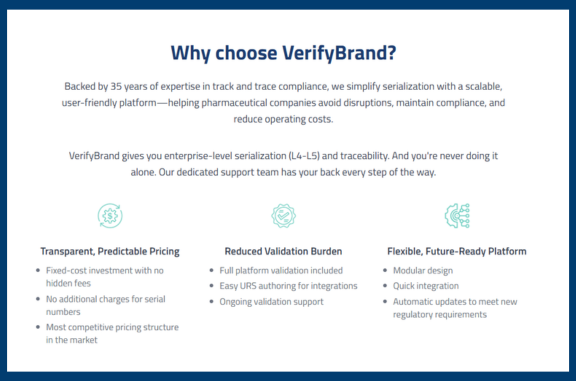
Why choose VerifyBrand

Ready to assess your options?

OPTEL’s VerifyBrand is built specifically for post-enforcement operational reality: GS1 EPCIS-native architecture, user-controlled exception workflows, fixed pricing, migration completed in under four months on average, and full validation support included.

If your reassessment is pointing toward a vendor change, the Switch to VerifyBrand page covers the migration framework, the transition approach, and what moving safely actually looks like in practice.